
October the 19th, 2026 – The Austro-Hungarians constructed the Istrian railway in just 3 years, but Croatia has been totally unable to connect it for 150!
Istria is the only Croatian region from which trains don’t actually run into the rest of Croatia. Although trains have been running across the peninsula for 150 years, a direct connection of the Istrian railways with the Croatian railway system is only now being planned. Dubravko Grakalic reports for Index that the Istrian railways are connected, primarily because of geography, to the neighbouring Slovenian ones – a project from the 19th century and the era of Austro-Hungarian rule. Back in 1867, when the line was opened to traffic, Emperor and King Franz Joseph I arrived in Pula by train via Slovenia. To this day, Istrian railway destinations are still reached in the same way.
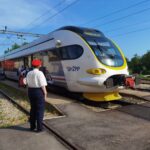
From Zagreb to Pula by train, via Ljubljana, one travels only at weekends. The train departs on Friday and after a seven-hour journey arrives at Pula station. From Pula back to Zagreb it returns only on Sunday. Passengers are also offered transport by train to Lupoglav, then by bus to the Rijeka–Zagreb line. The paradox of the Istrian railways, which today mainly serve freight traffic and local travel to Buzet, has an interesting historical and political context.
austria-hungary’s railway construction
“The railway in Istria was built back in 1876, with the line from the direction of Divača in Slovenia to Pula 122 kilometres long and a branch line 21 kilometres long from Kanfanar to Rovinj, which until that time had been the strongest economic centre of Istria. Although the Istrian population had wanted a railway earlier, because of other interests in the centre of the state in Vienna, whose primary goal was the construction of the line to the main maritime port of the monarchy in Trieste, completed in 1857, the construction of the railway in Istria was of secondary importance,” Dr. Sc. Josip Kajinić, curator of the Croatian Railway Museum of HŽ Infrastruktura and one of the authors of the recent exhibition on the railway in Istria, told Index.
“Circumstances changed as a result of foreign-policy circumstances that led to the construction of the monarchy’s main naval base in Pula in 1853, alongside which a shipyard was also launched. In those new circumstances the monarchy needed a safe and good transport link for the delivery of raw materials and military equipment, and given the poor and sparse road network and the danger from the sea for maritime traffic that threatened from the Kingdom of Italy after its unification, the decision was finally taken to build a railway line in Istria.
The line to Pula was built because of the naval base and the shipyard, and its branch to Rovinj for economic reasons. Because of the already mentioned danger that threatened from the sea, the Istrian railway was built through the interior,” Dr. Kajinić notes. The Istrianer Staatsbahn, as the railway through Istria was called in Austria-Hungary, was built at state expense. The law on it was passed on 22 April 1873, while the 122-kilometre line was built in less than three years by the company Frolich from Graz. Work began in Pazin in December 1873, and some twenty thousand workers worked on it. The cost was lower than planned – 12,760,469 florins. The line was solemnly opened in August 1876, and regular traffic started the same year in September.
By way of comparison, HŽ Infrastruktura began in 2025 the reconstruction of fifty kilometres of the line from the state border to Sv. Petar u Šumi. The plan is for the reconstruction to be completed by the end of 2028. Austria-Hungary built thirteen railway stations, five bridges and the Hum tunnel on the Istrian line.
the development of the line
In 1878 a track was built on the Pula waterfront, from the station to the shipyard. A more interesting line was built in 1887, a twenty-kilometre stretch from the Slovenian Hrpelje via Kozina to Trieste, which shortened the journey between Pula and Trieste. It operated until 1959 and is now an arranged cycling route. A similar fate befell the route of the narrow-gauge railway Poreč–Trieste, known as the Parenzana, Porečanka or Istranka.
“The former 123-kilometre-long narrow-gauge Parenzana line connected Trieste and Poreč, and for a length of 78 kilometres it passed through Croatian areas of Istria. It was built in 1902 and was in use until 1935. Its route is very well preserved and is today used for tourist purposes,” Josip Kajinić adds. The cycling and walking path is called the “Path of Health and Friendship” because it connects three countries.
from the former yugoslavia to the modern day
After the collapse of the once mighty Austria-Hungary, the first extension of the Istrian railways was launched by the then Yugoslavia with the construction of the Lupoglav–Štalije line in 1951. With it the railway was brought to the port in Raša Bay. The Kanfanar–Rovinj line was suspended in 1966 because of the developed road traffic.
“Throughout history the railway in Istria was managed by several administrations – from the Austrian, the Italian, briefly the German during the occupation in the Second World War, and after it the Yugoslav Railways, and since 1991 it has been under the management of the Croatian Railways, today HŽ Infrastruktura d.o.o.,” curator Josip Kajinić says and adds: “Today on the railway line between the Croatian-Slovenian border and the terminal station in Pula there are eight stations and 16 stops. This line is special in that it is probably the most authentic on the entire railway network in the territory of Croatia, with the largest number of originally preserved station buildings and other track facilities.”
michael portillo spotlights a vodnjan station
The cult British travel writer Michael Portillo presented in 2025 in the BBC series “Great Continental Railway Journeys” the station in Vodnjan with its old-fashioned technology that is still in use today.
The story of the railways in Istria is also shown by the recent exhibition “Gremo na makinu!” at the Historical and Maritime Museum of Istria in Pula, as well as the steam locomotive of the FS 835 series located next to the station building in Pula, which is a protected cultural asset and part of the holdings of the Croatian Railway Museum. “With the exhibition we wanted to show how important the railway was for the development of Istria, not only in a transport and economic sense, but also in the everyday life of people. We sought, along with a historical overview of the construction and development of the lines, to present objects that tell us about the functioning of the railway and the people who worked on it. It is particularly interesting that part of the exhibited material is available to the public for the first time, and the former lines that, although they no longer exist today, played an important role in connecting Istria are also covered,” they say for Index at the Historical and Maritime Museum of Istria in Pula.
The government and Croatian Railways have also revived the plan to connect with the Istrian lines by a tunnel through Učka. Although the foundation stone for the construction of the tunnel under Ćićarija was laid as early as 1993 by the then Croatian president Dr. Franjo Tuđman, the state company HŽ Infrastruktura only in May 2026 signed a contract for the documentation and conceptual design of that tunnel. The project should be completed in two years and will cost around two million euros. When the Istrian railways will be directly connected with the rest of Croatia is still not remotely known.