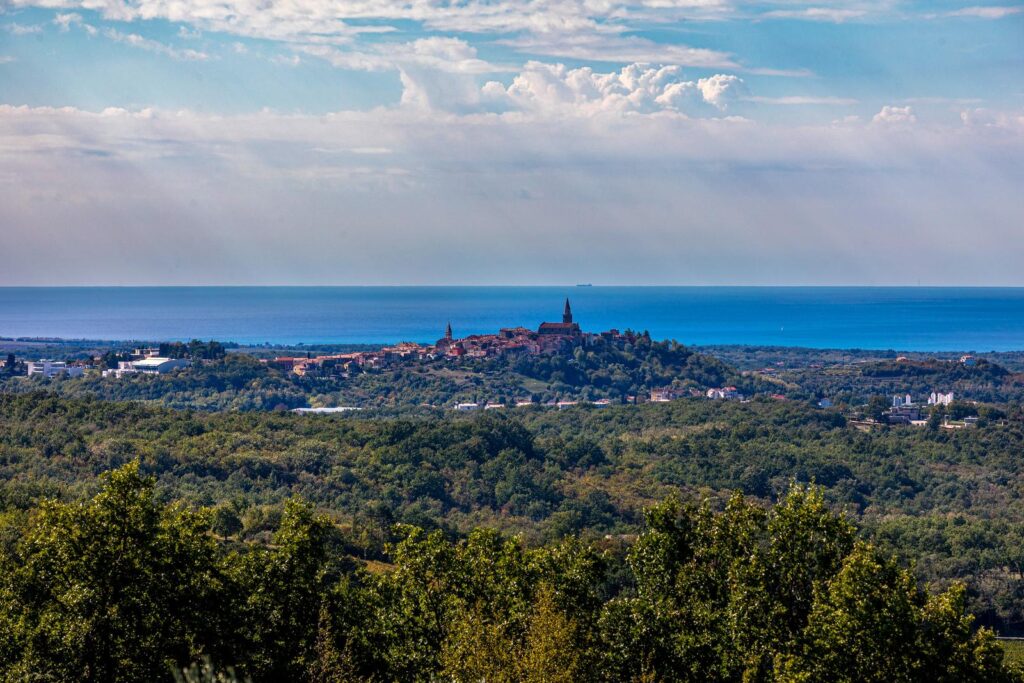
October the 13th, 2025 – The interior of Istria is stunning, and charming little Buje is the ideal weekend getaway. It even boasts a bell tower from which you can see not only Croatia, but Slovenia, Italy and even Austria.
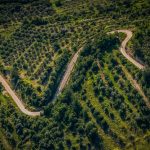
As Putni kofer/Ivana Vasarevic writes, few parts of Croatia look as fairytale-like as the mountainous interior of Istria. The region’s unbelievably beautiful towns surrounded by unspoiled nature never cease to amaze all those who gaze upon them, and Buje is certainly one of them. Situated high on a fertile hill, embraced by centuries-old vineyards and olive groves, this Istrian gem was inhabited as early as the Bronze Age, and today has around 3,000 inhabitants. It is only 13 kilometres from the crystal-clear Adriatic Sea (Umag) and the Slovenian border is also very close. Buje really is the ideal Istrian weekend getaway.
former inhabitants called a castle in buje home
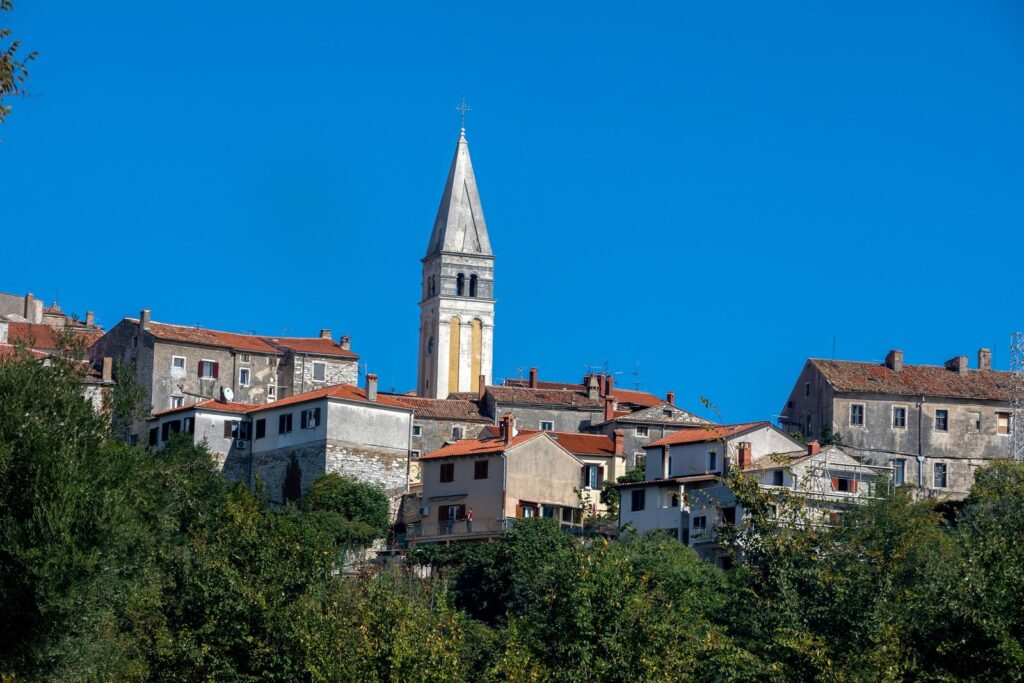
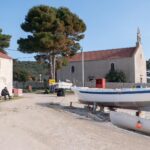
Its ancient inhabitants once lived in a fortified castle, the remains of which can still be found in Buje and the surrounding area. The town itself is now an ancient labyrinth of charming cobbled streets will lead you to the core of the old town and Freedom Square (Trg Slobode), where you will be greeted by the magnificent Church of St. Servulus and its stunning 15th-century bell tower.
a bell tower with a front row seat to four nations

In good weather, it offers a fantastic view of four countries, Croatia, Slovenia, Italy, and even Austria. This beautiful bell tower is one of the highest in all of Istria, and since it’s located at 222 metres above sea level, it’s only natural that it was once an important lookout and guard post. It was once aptly nicknamed the guardian of Istria. In addition, its image was also used on Buje’s seal from the 13th century.
There is also the bell tower that proudly stands next to the Church of Our Lady of Mercy (St. Mary of Mercy). It dates from the 17th century, is 22 metres high, is adorned with a clock, and at its foot there is a characteristic passage, across from which there is an ethnographic museum. In the aforementioned church itself, you can see the sculpture of Our Lady of Mercy, one of the most beautiful wooden statues in all of Istria.
Way back during the Iron Age, the entire area around Buje was inhabited by the Histri, the first documented people on the Istrian peninsula, with the Romans also having colonies in Terra Magica. During the Middle Ages, a fortified medieval town gradually developed, and for the first time in written documents, more specifically in the charter of the Holy Roman Emperor Otto II, Buje was mentioned in 981 as Castrum Bugle.
istria – passed from pillar to post during tumultuous times

At the beginning of the 15th century, the entire Buje region came under the rule of the mighty Venetian Republic. Over the four centuries which followed, a magnificent bell tower, the impressive church of St. Servulus (Buje’s patron saint) and the city loggia, which was located on Freedom Square, were all built there. To this very day, the tower of St. Martin, which was part of the original Venetian walls, has survived from that period.
After the fall of the Venetian Empire in 1797, the French, the Austro-Hungarian Monarchy and the Kingdom of Italy alternated in power in Buje. After the end of World War II, Buje and its surroundings ended up in the Free Territory of Trieste. Its status was only regulated in 1954, when it was agreed that the northern part of the Territory, Trieste and its surroundings, would all belong to Italy, and the southern part, including Buje, to the then Yugoslavia.
If you do find yourself in Buje for that ideal weekend getaway, make sure to check out the aforementioned ethnographic collection in the local museum. It is home to fascinating folk art from across the entire Buje region. It is located in a magnificent four-story building, and exhibits tools, furniture, and everything that made up a typical old-fashioned household, once focused entirely on agriculture and ancient crafts.
In the basement, you’ll find a blacksmith shop and an old olive processing plant, including a press, a millstone, and stone vessels with wooden lids in which olive oil was stored. Traditional Istrian cuisine and valuable pottery items are exhibited on the first floor, and the biggest attraction of this part of the museum is the hearth, the lifeblood of every single real Istrian household.
The second and third floors are reserved for a loom and antique carved chests, in which clothes and other personal items were once kept. In addition to all of the above, the third floor is often used for occasional exhibitions of an ethnographic and historical nature.
agriculture, castles and plenty of wine

Buje is the perfect weekend getaway precisely because its surroundings are just as interesting. A stone’s throw away lies the pretty little settlement of Momjan with its imposing medieval castle above the Dragonja River. There’s also the Istrian desert of Piski, an utterly unique natural phenomenon known as marl dunes, one of the greatest attractions in all of northwestern Istria that really does look impressive.
After sightseeing in this magical town and exploring its surroundings, the time comes to explore the wine and olive oil roads of the Buje region. Enjoy delicious Istrian cuisine and excellent wines, as well as great homemade beer, which has been produced in the Buje brewery San Servolo since 2013.