January the 12th, 2026 – Dry-stone walling is synonymous with Croatia, particularly across Dalmatia and the islands. Did you know however that Croatia is actually home to one of the most strikingly beautiful dry-stone walling systems in all of Europe? Let’s head to Krk…
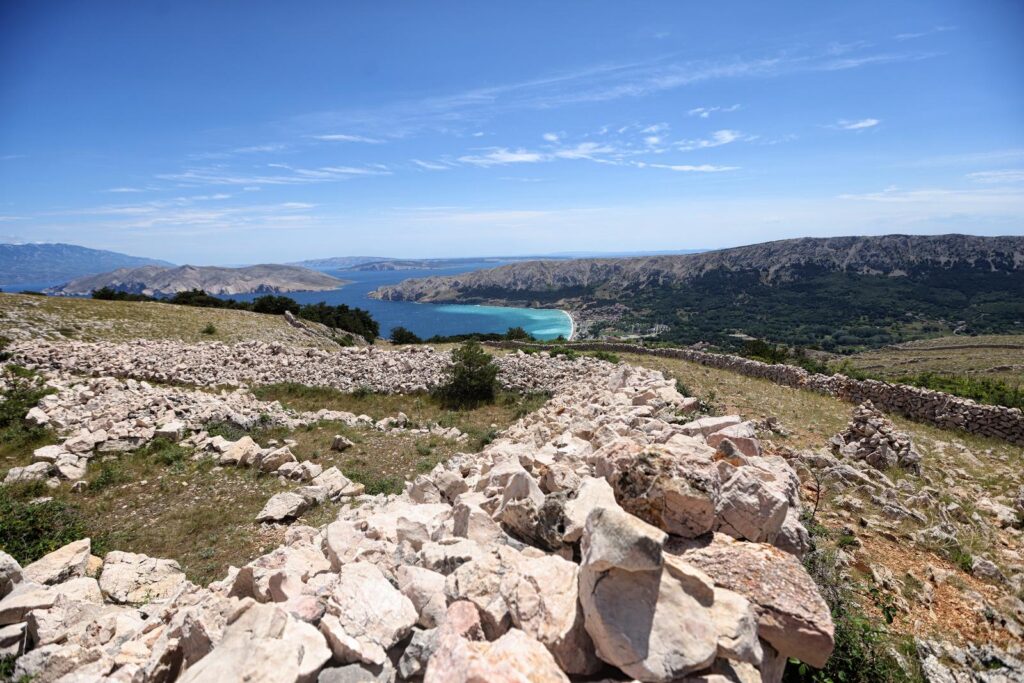
As Putni kofer/Martina Hrupic writes, they’re mentioned under two names. One is romantic, somehow gentle… The other is harder and evokes strength. Whatever you call them, they’re symbolic of absolutely incredible beauty. Mrgari, or the stone flowers of Baška, are a reminder of bygone times, a monument to human effort and sheer grit, as well as to life spent in harmony with nature. They adorn the hinterland of Baška and the plateaus in the background of its beautiful beaches. They stand like silent watchmen against the karst and barren vegetation and, in short, represent one of the most beautiful examples of dry-stone walling in all of Croatia.
All the splendour of their beauty, like some fine stone lace, is best expressed when observed from a bird’s eye view. It’s only then that it truly becomes crystal clear why they are called the stone flowers: the floor plans of these dry-stone constructions truly resemble clusters of petals.
“What is certainly the most monumental work of Croatian shepherd architecture that I’ve ever seen is located on the bare karst plateau, just east of Baška… In a rocky area where the rocks are as sharp as knife blades under your feet, and vultures and seagulls circle high above you, there, in the middle of a flock of sheep, stands Veli mrgar like some kind of prehistoric temple in Malta,” stated Branko Fučić, a Croatian academic and art historian back in 1997. With these words, he confirmed their beauty, as well as their sheer level of importance for the historical and cultural story of the island of Krk.
What are mrgari, anyway? Simply put, Mrgari are constructions intended for collecting and sorting sheep. They consist of a common, central space, the so-called ‘hall’, and the small mrgari that are ‘arranged’ around the hall like flower petals. Each of these sheepfolds belonged to one of the local shepherds, and the entire structure was built using the dry-stone technique, i.e. by stacking stones without the use of binding material.
“They were used so that all the shepherds could drive their sheep from the communal pasture towards the funnel-shaped entrance of the sheepfold. When the sheep had gathered in the hall, the entrance would be closed off and each shepherd would separate their own sheep and lock them inside the sheepfold. When they had finished their work in the sheepfold (examining the sheep, shearing them, or doing something else), they would release them through the outer opening of the sheepfold back into the communal pasture to graze,” as is stated on the official website of the island of Krk.
Today, sheepfolds can be found in the southeast of Krk, on the karst limestone plateaus above Baška, at altitudes of up to 400 metres, as well as on the nearby island of Prvić, the largest uninhabited island in all of Croatia. Despite the passage of time and the elements, there are still fifteen of them: five on Prvić, and ten in the hinterland of Baška, five on each of the two plateaus there.
On the southwestern plateau, there are Mrgari na Ljubimer, between Bag and Gabor, and Mrgari na Kovačin, between Gabor and Vorganj. There are also Mrgari na Vratudi and Mrgari na Jakoša. The aforementioned are located at altitudes of 125 to 350 metres above sea level, while the fifth one there, Mrgari na Lipica, is the highest of them all. It is located at a dizzying 405 metres above sea level, between Veli Hlam and the Orlje ridge, and was abandoned entirely back in 1958.
On the northeastern plateau, you’ll find Mrgari na Rebica, on Starošćina, and two on Stari Mrgari, the ‘old’ and the ‘new’. Finally, there are the Mrgari va Pothlamac, at 400 metres above sea level. Generally speaking, the mrgari had a capacity of 500 or even 2000 sheep, depending on the locality in question.
The mrgari were created thanks to the shepherds from the Baška Valley, primarily those from Baška, Batomlej and Jurandvor. The shepherds from these places also built and used the mrgari on the neighbouring island of Prvić.
These ancient mrgari were not only a useful construction in which the shepherds could count and shear their sheep. They were also a place of social contact, meeting and gathering together. Entirely unique and appearing utterly beautiful when bathed in the rays of the setting sun, even today: history, tradition, culture and beauty come together seamlessly within their ancient stone.