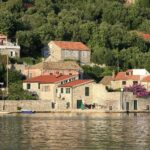

November the 17th, 2025 – There’s a Croatian ghost village that few have ever heard of, sitting abandoned on the Pelješac peninsula, from which the last resident fled in 1991.
As Putni kofer/Martina Hrupic writes, there’s a Croatian ghost village located on the beautiful Pelješac peninsula that simply steals your heart. That could be another reason why almost everyone who sets foot on Pelješac falls in love with this very special part of Croatia. There are many reasons one could list; the truly beautiful sea, unspoiled nature, imposing mountains, quaint bays and beaches, and not to mention the excellent local wine, food.
Few mention this Croatian ghost village which has sat with the sound of little else but crickets and the bura since 1991 – it is called Nakovana. Situated not far from Orebić, its story is a quiet one, hidden from the summer tourist crowds, but very loud in scientific and archaeological circles.
Nakovana is an area of Pelješac that stretches from Sv. Ilija, the highest peak of Pelješac, all the way to Lovište. It has been declared an eco-archaeological zone, and within lie two ancient settlements: Gornja (Upper) and Donja (Lower) Nakovana. Only one family can call themselves Nakovana locals currently.
the legend of the blacksmith brothers…

The legend goes that once, there were three blacksmith brothers living in that part of Pelješac. When the time came to divide up their property, the calculation was as follows; one brother got the housing, that is, the house in which the blacksmith shop was located. The local town of Kučište was named after it. The second brother got the blacksmith’s tongs, the so-called viganj, and today’s settlement of Viganj, known as the Croatian capital of windsurfing, came to be. The third got the anvil (Croatian: nakovanj). Naturally, the place where he lived was called Nakovana.
This is just one of the possible explanations behind this Croatian ghost village having such an unusual name. Its true origins remain entirely unknown. What we do know is that it was first mentioned way back in 1335 as Nacovalda, and later as Nacoualna and Nachovalna. Some say that it got its name from a hill with a specific name there, which was once called Nakovanj, and which is now called Grad. This makes sense, given that the neighbouring hill is also named Nakovanić… Another says that the Celts may have given it the name when they descended all the way down to Pelješac and southern Dalmatia.
an 8000 year story of grit and determination

In any case, Nakovana, which is a mere six kilometres from Viganj, is one of the oldest human settlements on all of Pelješac, and its surroundings were inhabited 8000 years ago. It was also once one of the largest, undeveloped places on Pelješac. Despite this long history, its much more recent history is deeply sad. Many of its original inhabitants were displaced throughout the rest of Pelješac (they founded Lovište) or even the world, for example, Australia and New Zealand. In 1991, when Croatia was engulfed in war, ancient Gornja Nakovana was finally abandoned by its last permanent resident. Donja Nakovana, which is home to the single remaining family mentioned above, is somehow holding on – just. Becoming a Croatian ghost village in 1991, it became the target of thieves. Not even the church was spared.
the home of the richest site of illyrian culture on earth

Despite all of the turbulence, something did end up being preserved. In fact, this was all a very well-kept secret, hidden behind the ancient Dalmatian stones by mere chance. That’s the entrance to the local cave Spil(j)a Nakovana, which is considered the richest site of Illyrian culture in the whole world. It is one of the rare places that were not discovered by chance by passers-by, but instead by archaeologists. What awaited them behind the stones, which had guarded the cave for over 2000 years, was beyond fascinating.
Those archaeologists found an Illyrian temple there, in which fertility was probably celebrated: everywhere around a 60-centimetre-high stalagmite in the shape of a phallus, they found thousands of remains of various dishes for serving drinks and food. The oldest zodiac record in the world was also found there, in the form of an ivory tablet. The oldest traces in this incredible cave date back to around 6000 years BC. In addition to being farmers, these ancient people, members of the Nakovana culture as it is called among professional circles, were also excellent sailors.
That’s not all. Archaeologists are also fascinated by the Illyrian hillfort in Noakovana, as well as Illyrian burial mounds, of which there are at least 100 in the area. According to legend, they buried cursed treasures guarded by snakes, and in one of them, items of women’s clothing and jewellery dating back to the 11th century BC were found. Kr. The fascinating Nakovana area is also home also the oldest church on Pelješac.
If you’re anywhere near this remarkable part of Dalmatia, perhaps tasting wine or enjoying the beach, make sure to make time for a visit to this ancient Croatian ghost village.