
December the 22nd, 2025 – Dalmatia is full of architectural wonder that spans ages, empires and regimes, but did you know that it’s actually home to one of the oldest squares in all of Europe?
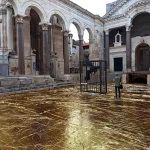
As Putni kofer writes, Dalmatia is home to one of the most beautiful and also one of the oldest squares in all of Europe – and you’ll find it in the very heart of Split. If you’re at all familiar with Croatia’s “second city”, you’ll likely have clocked that we’re talking about the gorgeous Peristil. It has been the city’s beating heart for a whopping seventeen centuries. There are few places in Europe where such a sheer abundance of history is not only preserved in books and museums, but is also experienced daily on the same stone that Roman emperors, bishops, merchants, and countless residents walked on throughout the many long centuries.
Try to compare its age for a moment with the now famous and recognisable European squares in Venice, London, Paris, Madrid, or Berlin… While these major cities shaped their central squares much later on, Split’s Peristil has been a place of meeting, ceremonies, and public life for centuries before them. It’s precisely this long history that makes it a unique square in the European sense. When taking a stroll through it, you instantly feel the layers of time in the ancient stone underfoot, and at least for a moment, you too become part of the story that has been penned here for ages.
a central stage for roman power

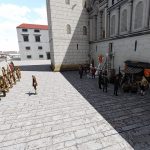
The central square of Diocletian’s Palace was designed way back at the beginning of the 4th century as the representative centre of the imperial residence and one of the most important places in what was then Split. In Roman times, it served as a ceremonial courtyard in which the emperor appeared before his subjects, and it was precisely in this area that rituals designed to emphasise the power, order and greatness of the Roman Empire took place. This ancient square is surrounded by monumental columns, temples and the emperor’s mausoleum, and historians say that this area of Split has embodied order, authority and imperial power for centuries. Today, it’s one of the most beautiful man-made places in all of Dalmatia by far.
The square was intended for Emperor Diocletian, celebrated as the living son of Jupiter. The emperor appeared under the architrave arch in the central part of the protiron, while his subjects approached him with deep respect, kneeling and kissing the hem of his scarlet cloak or falling to the ground before him, lying with their entire bodies on the ground as a sign of respect. The ceremonial role of this impressive space is further emphasised by the red colour of the imposing granite columns, because it was from the time of Emperor Diocletian that purple became the exclusive colour of imperial dignity.
even after the fall of the mighty roman empire – the square lived on

What makes this square so different on the wider European scale is the fact that it never lost its role as a public space. While numerous ancient squares were eventually filled in, abandoned, or turned into carefully preserved museum sites, Peristil continued to live and develop together with the city through the ages. After the fall of the Roman Empire, the palace area gradually took shape into an urban centre, and the square naturally took on the role of a city square. For centuries since then, people met there, held ceremonies, and social and religious life all played out there, without interruption and almost without changing its basic purpose at all.
Its stunning design in the very heart of Dalmatia’s biggest city made this square among the most beautiful in Europe, and thanks to its exceptional beauty and special acoustics, it eventually became a natural theatre stage. It looked as if it was entirely created for opera classics and works of ancient literature, as well as a place where regular city life takes place. Drinking coffee on the steps surrounding the square is a unique experience and one of the most direct encounters of modern man with ancient heritage.
you don’t need to go to egypt to see a sphinx
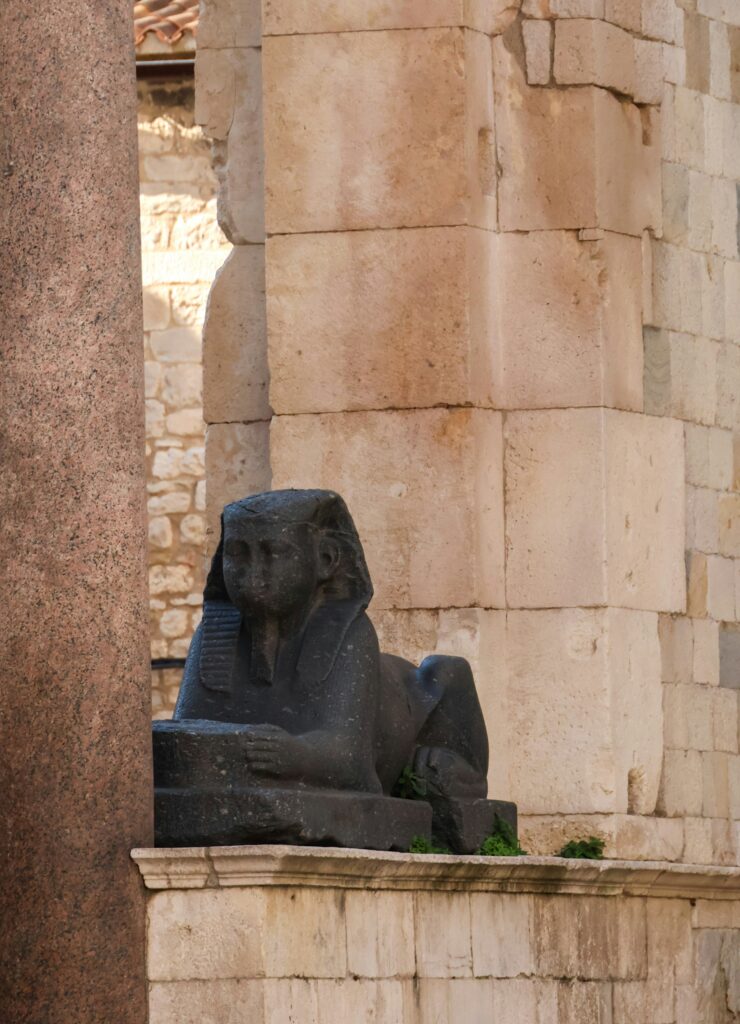
At over 3,500 years old, an exceptionally well-preserved sphinx watches over this ancient square as a silent and dignified feline witness to the layered and turbulent history of Split. It was brought to Croatia from Egypt during the construction of Diocletian’s Palace. It was in front of this ancient sculpture that Pope John Paul II, enchanted by the power of the space and the depth of the historical heritage, uttered the words “My God, how many feet have trodden here”. This sentence powerfully summarises the feeling that this square still evokes to this very day. For this reason, the people of Split experience it not only as a square, but as the living heart of the city and a place where the past and the present meet.
The sphinx dates back to the time of Pharaoh Thutmose III, and is considered one of the oldest objects in Split. It belongs to the group of andro-sphinxes, creatures that had a combination of a feline’s body (more specifically a lion) and a human head. This one in Split is also interesting because its limbs end in human hands, not the claws of the king of the animals – the cat. Apart from its location, thousands of kilometres from Egypt, the Split sphinx is also unusual in that it holds a vessel for sacrificial offerings in its hands, which is a symbol of the king’s vow to the gods and is a rare detail on similar monuments.