
October the 14th, 2025 – The incredibly interesting Danilo archaeological site is a Roman era gem, and it’s just a short distance from bustling Šibenik.
As Putni kofer/Lana Mindoljevic writes, at first glance, it looks like your typical, quiet Dalmatian local cemetery, in the heart of which sits an old stone church surrounded by gnarled olive trees and rows of vineyards. It’s far more than that, however. This location is so much more than just another peaceful and picturesque village in the Dalmatian hinterland. That it is quite atypical is quickly revealed by the view of the meadow along the old road, right across from the entrance to the cemetery. There, large boulders have been placed in regular shapes, somehow meaningfully, in some kind of order, as if they were the keepers of ancient secrets…
This is the interesting Danilo Roman site, a settlement that falls within the bounds of the popular city of Šibenik, which is only about 15 minutes by car from there. On the site of what is now a small and peaceful village, a Roman city once flourished…
turning the clock back by 2,000 years…
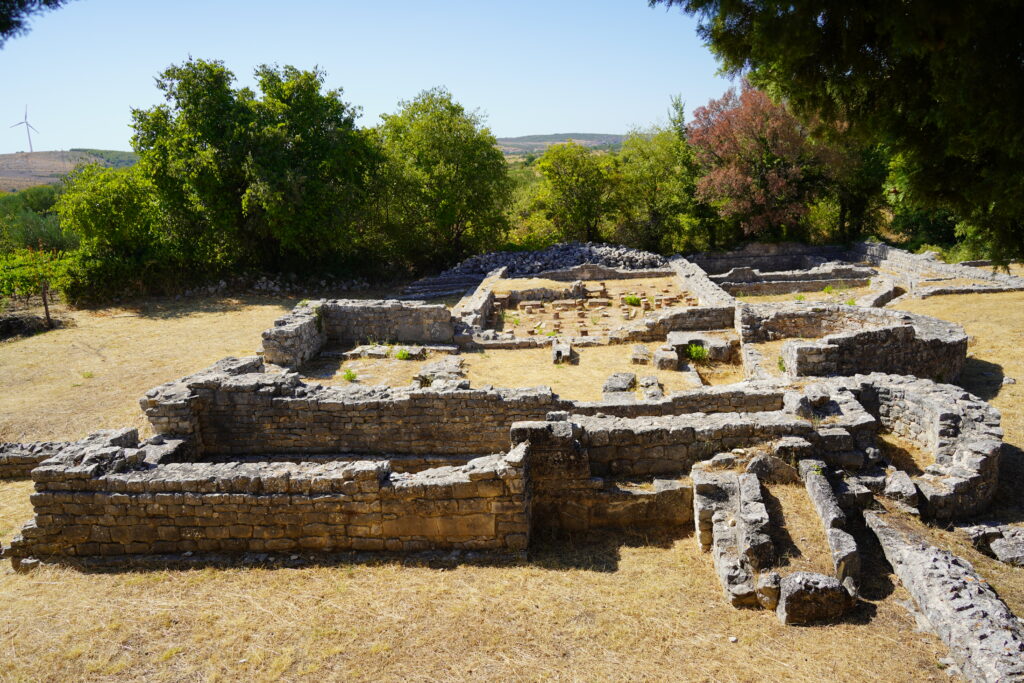
While Danilo is a small settlement with a few hundred inhabitants living there today, 2,000 years ago there was a lively Roman city in its place. It wasn’t as big as the much more well known settlement of Salona near Split, but it was very important for the Šibenik and Skradin areas. Back during Roman times, the municipium Riditarum was one of the more significant localities in the Dalmatian hinterland, located along the road to the Burnum military camp. The Romans established power in this area way back at the beginning of the 1st century, but the settlement existed even earlier, long before the Roman invasion. The Delmati people lived in the Danilo area, after whom this ancient city was actually named.
The original settlement was located on a nearby hill, known as Daniloska gradina. During the 1st century, the inhabitants slowly began to descend into the fertile fields below to take up agriculture. The fields and plains were usually not settled because the land was precious for cultivation, so the ancient houses were built on the edges. Such was life before the arrival of the Roman conquerors, who have left so much of themselves dotted along Croatia’s coastline and islands.
With the arrival of the Romans, in the 1st century, the municipium Riditarum was founded right next to the parish Church of St. Daniel (Sv Danijel).
GPR showed that under the foundations of the church of St. Daniel there are remains of monumental Roman architecture, almost certainly a temple. The dimensions of the stone blocks, bases and capitals indicate a large public building. The settlement also included a forum, a central square, and next to it a thermae, or public bath. It had underfloor heating, or hypocaust, and pools with cold, warm and hot water. During a later period, on the site of one of the pools, an early Christian chapel with an apse was constructed, which testifies to the very early penetration of Christianity into Dalmatia and its hinterland. Before the arrival of the Romans, the community was headed by local leaders, princeps, who retained an important role in the administration of the municipality even after the Roman conquest.
most of the ancient roman city remains below the ground
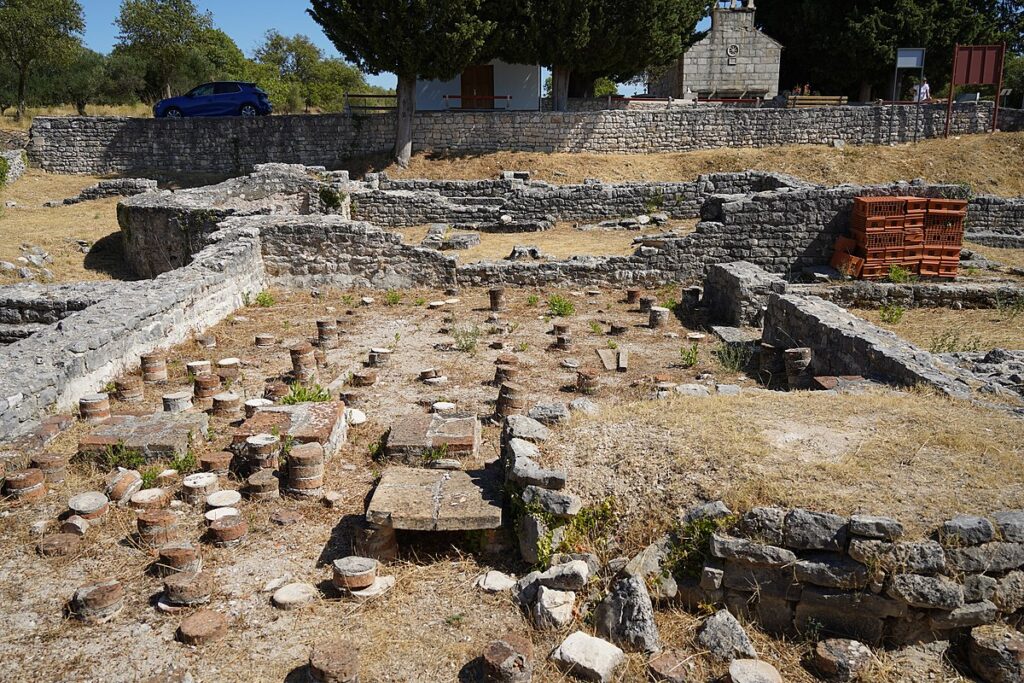
The vast majority of the former Roman settlement in Danilo still lies underground at a depth of two to two and a half metres below the current surface. Over the centuries that have since passed, erosion has occurred and in some places large deposits of clay have formed, probably as a result of floods during late antiquity and the early Middle Ages. This is why classical archaeological excavations at the Danilo Roman site near Šibenik require much more effort.
As for the number of former residents, it’s difficult to give educated guesses or estimates. Estimations can only be made based on the size of the settlement, the capacity of the water supply system and individual public buildings. That said, it’s certainly a settlement that had all the usual elements seen in a developed Roman city.
Archaeological research at the Danilo Roman site near Šibenik began back in 1951 and continues, with short interruptions, to this very day. Thanks to modern technologies, such as ground-penetrating radar and spectral analysis by drones, it’s now far easier to understand the way of life in the former Roman city. A good part of the settlement has been explored, although most of the finds are buried again for their own protection or because they’re actually located on private plots of land.