
November the 10th, 2025 – There’s a Vrlika bridge that looks like most others at first glance, but has been surrounded by all kinds of archaeological wonder, especially when it comes to fascinating Roman finds.
As Putni kofer/Ivana Vasarevic writes, in the far north of Split-Dalmatia County, nestled between the mighty Dinara and Svilaja mountains and the Cetina River, lies the picturesque town of Vrlika. It lies at 470 metres above sea level, on the very edge of the Vrlika plain, and its surroundings are adorned with plenty of natural beauty, as well as historical and cultural landmarks. One of the most fascinating in all of Vrlika is Balečki Most (Bridge) which sits over the aforementioned Cetina River, not far from the little village of Vinalići.
It was built in 1907 during the Austro-Hungarian era, as part of the road connection of the Dalmatian hinterland. This Vrlika bridge is made of polished dark grey stone, is 45 metres long and 5 metres wide, designed as a two-way road, and was built by local craftsmen.
The bridge boasts three semicircular openings of equal size (a little more than 9 metres each), which rest on stone pylons with a rectangular cross-section. It is widely considered to be the highest bridge in the whole Sinj region, and in terms of shape and construction it is similar to other bridges that can be seen throughout Dalmatia, dating from the second half of the 19th and the beginning of the 20th century.
The front wall of the bridge ends with a rectangular-section cornice, which extends along its entire length. The stone fence has larger and sloping cover plates, and the structure of the entire bridge on the upstream and downstream sides is reinforced with conical-shaped wing walls, which are also made of roughly processed stone.
Along the fence itself, i.e. immediately above the cornice, there are also openings for rainwater drainage. The level of the bridge is horizontal, and the entire area around it, including the bed of the Cetina River, is a large archaeological site where very many artefacts from prehistoric and ancient times have been discovered.
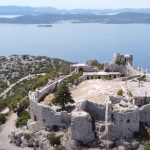
On the south side of this interesting Vrlika bridge, right above the right bank of the Cetina River, you’ll see a construction called Balečka gradina, which is a large ancient fortress. A multitude of ancient (most frequently Roman era) inscriptions have been found around the bridge itself, while an even older bronze sword was discovered in the Cetina Riverbed just below.
In the area of the nearby hamlet of Jare, you can see the remains of an ancient Roman villa rustica, with the western approach to the Cetina River protected by the so-called Kosorska glavica, on which another expansive ancient fortress is perched.
This beautiful Vrlika bridge was renovated in 2014, retaining its full original architectural form, and it was also entered into the Register of Cultural Heritage of the Republic of Croatia. It isn’t the only Vrlika bridge worth paying a visit to, either. If you happen to find yourself in the area, make sure you visit Pločasti most (Slab Bridge). This construction is totally unique in that it is composed of medieval stone megaliths, stećak tombstones, i.e. tombstones, which are believed to have been brought there way back during the 15th century from the cemetery near the hamlet of Vranješi.