
December the 8th, 2025 – Croatia’s highest cliff is half the height of Paris’ dazzling Eiffel Tower, and one of the world’s most stunning national parks can also be found right there.
As Putni kofer writes, there’s an incredibly beautiful part of Croatia entirely dictated by contrasts, including the one between gentle, friendly beaches and brutally, terrifyingly steep cliffs. In fact, Croatia’s highest cliff is half the size of the Eiffel Tower, it’s called Telašćica and it is located in the southeast of Dugi Otok. This utterly exceptional bay has enjoyed the status of a protected area for decades now – and with good reason. Telašćica was declared a nature park back in 1980 due to its extraordinary landscape diversity, rich flora and fauna, and valuable archaeological and geological findings that testify to the long history of ancient human life in this area. It’s also home to Croatia’s highest cliff, which is actually the highest in the Adriatic. This rugged natural fortress is a phenomenon of nature that leaves anyone who approaches it stunned.
croatia’s tallest cliff, with Grpašćak as the crown

Telašćica Bay is located in the southeastern part of Dugi Otok, in the very heart of the expansive Zadar archipelago. It is an area of exceptional natural value, surrounded by a series of islets, hidden coves, and steep karst coastline, which is the reason why it was declared a protected nature park. On the northern side of the bay, where the view opens up to the open sea, you’ll immediately notice towering imposing white cliffs known locally as “stene” (rocks). This is the most dramatic sight in the entire area by far. The deep blue sea below them plunges abruptly into the depths, while the cliff itself rises vertically above the surface.
The highest point of this stunning cliff in Telašćica Bay is called Grpašćak and rises as high as 161 metres above sea level. To illustrate just how impressive this is, it is enough to compare it to the Eiffel Tower in Paris, which is about 300 metres high, or a little over 320 metres when the antenna is included. We can say that Croatia’s highest cliff in Telašćica is almost half as high as one of the most famous symbols on Earth, which immediately reveals the scale of the natural spectacle that awaits visitors there.
70 kilometres of protected natural wonder

The Telašćica Nature Park covers almost 70 square kilometres of exceptionally indented and preserved space. Of this total area, approximately 26 square kilometres are land, mainly Dugi otok and the surrounding islets, while the rest is made up of the sea, which plays a key role in shaping the landscape and life in it.
Telašćica Bay itself is often described as the safest, most beautiful and largest natural harbour in the entire Adriatic. The maximum depth of the bay reaches 67 metres, and its characteristic shape resembles three interconnected lakes. It’s precisely because of this appearance that in ancient times it was known as Tilagus, from which its current name later emerged.
Within the bay itself, there are 25 beautiful beaches and some other smaller bays, each with its own character and the colour of the sea. The area is intertwined with a whole series of islands and islets, which further contribute to the picturesqueness and uniqueness of this stunning area. Depending on the part you happen to be in, the landscape alters like a stage: from quiet pebble beaches and shade provided by dense Mediterranean pine forests, to harsh, dry rocky areas, to steep cliffs that tower over the sea in a dramatic meeting of land and open sea.
a salty surprise – lake mir
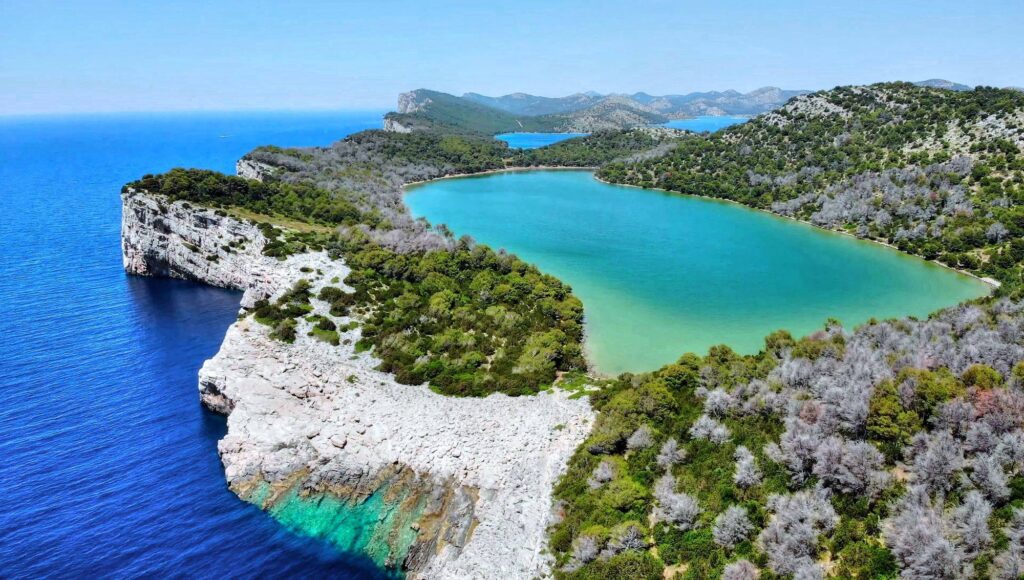
In addition to the spectacular cliffs known as “stene”, Telašćica Bay also hides another surprise – a salt lake called Mir, or Peace in English. Its sheer beauty and unusual nature further enrich this very special corner of the Adriatic. What makes this lake unique compared to the sea is its increased salinity. The reason for this lies in the cracks that connect it to the sea. They are very narrow and partially permeable, meaning that the sea water reaches it slowly, and evaporation, especially in the heat of the summer, further increases the density of the saline solution in this body of water.
It’s especially interesting that the temperature of the water in this lake often differs greatly from the temperature of the sea that surrounds it. In summer, the water in Lake Mir usually warms up to as much as 33 degrees, which is why swimming here is like enjoying a warm natural pool. It’s exactly this diversity that makes the lake a natural lure to those who find the sea a bit too cold, even in the height of the sweltering Dalmatian summer.