March the 10th, 2026 – Croatia is famous worldwide for its sporting talent, particularly when it comes to football. Few realise however that there’s a Croatian football stadium that was once declared as being among the most unusual in the world.
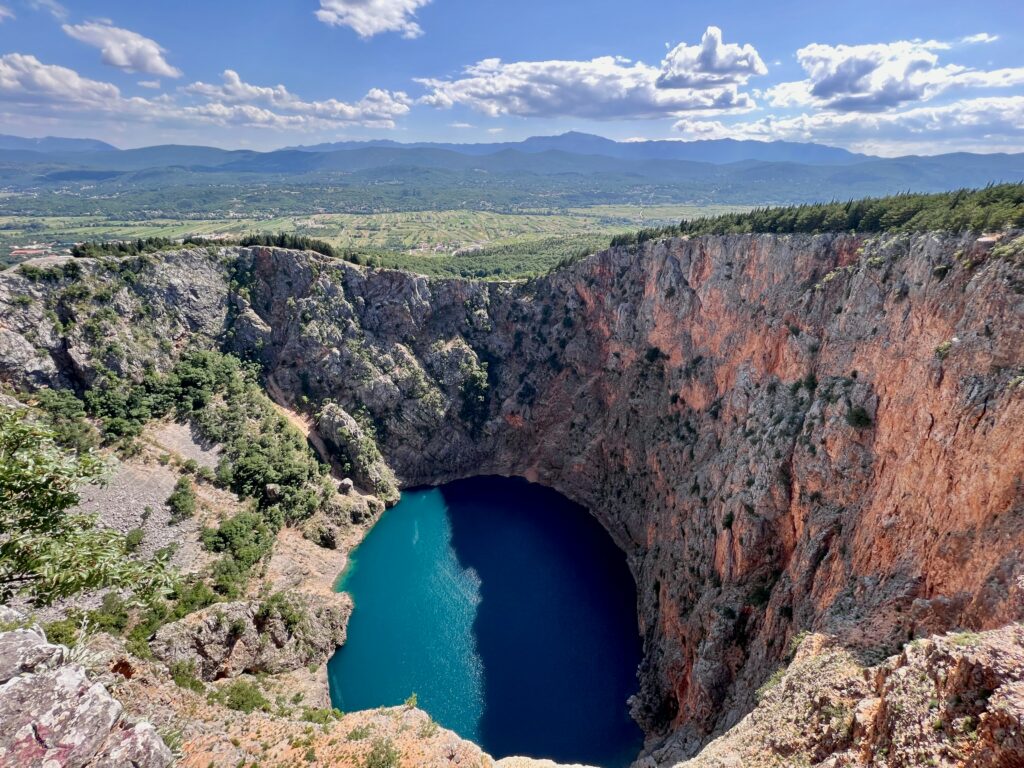
As Putni kofer writes, Imotski is a town in Dalmatia’s harsh and rugged hinterland that is simply full of surprises. Its rough beauty culminates in the unexpected contrast of water and rock, and the scorching sun beats down on its traditional old houses and streets. The old town core transports you directly back to a bygone time, and that’s without even mentioning Imotski’s untouched nature. The famous Red and Blue Lakes, the Vrljika River, the Biokovo Nature Park, the Lokvičić Lakes, and the list goes on.
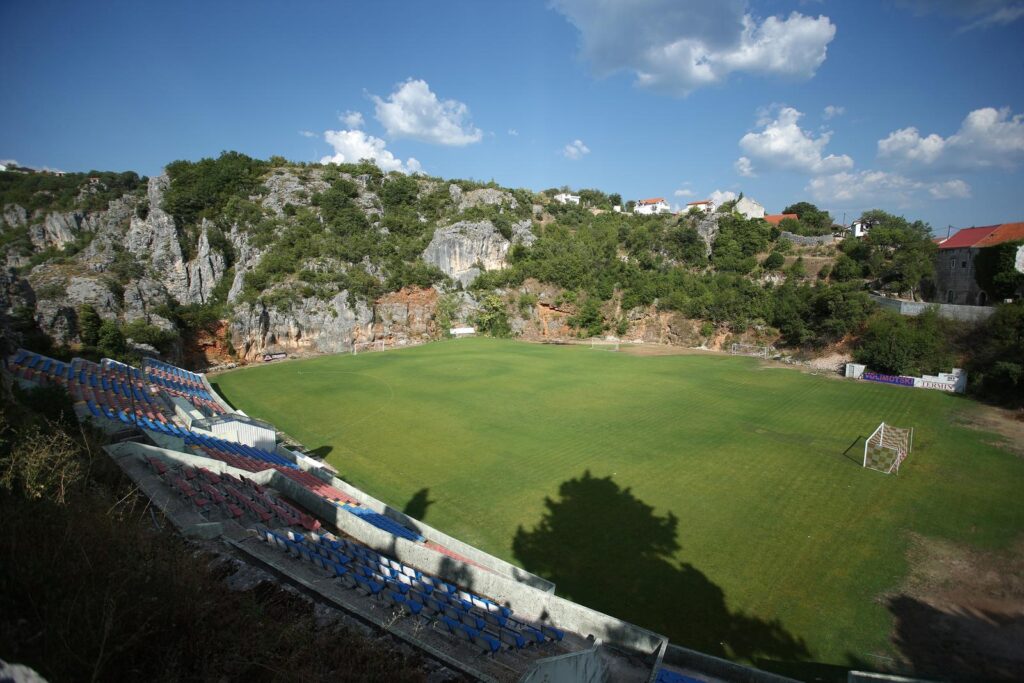
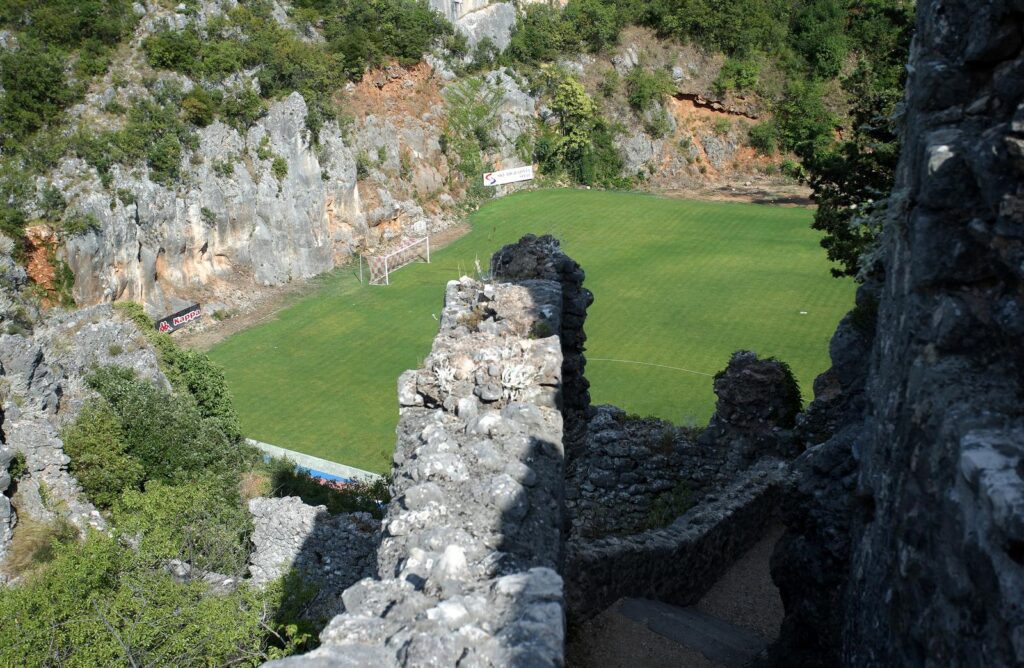
It isn’t all about the mountains, lakes, rivers and traditional architecture, however. One thing not to bypass is the Croatian football pitch which lies here and was once declared as being among the most unusual in the entire world. This is the Gospin Dolac stadium, which is actually located in a sinkhole at the foot of the historic Topana fortress. Unsurprisingly, the BBC included among the ten most amazing sporting arenas in the whole world. This year, the stadium will celebrate its 50th birthday, and it has been announced that a thorough renovation that won’t damage its truly unique appearance is soon set to begin.
plans for the croatian football stadium declared the most unusual in the world
According to Slobodna Dalmacija, this extensive and careful renovation project envisages the expansion of the stadium’s capacities to around 5,000 seats. The plans also include the construction of a public garage and a roof area that would serve as an elevated square and a lookout point towards the Blue Lake and Topana. Special attention has been paid to preserving the view of this ancient fortress and the rocky cliffs, as well as the phenomenon of watching matches taking place below from the rocks situated above the stadium.
According to the project’s plans, this utterly unique stadium would meet the requirements for almost all levels of club competitions under the auspices of UEFA, except for the finals, which require a larger capacity. It would enable the holding of international matches, concerts and all sorts of other events.
Imotski’s local team regularly plays its home games at the Gospin Dolac stadium, and it was named after the votive church of Our Lady of the Angels, which is located in the immediate vicinity of the stadium. It currently has 4,000 seats, of which 3,000 are seated (new chairs made of recycled plastic were installed in 2024), and 1,000 are standing. It’s a particular spectacle in the evening, when it sparkles under the powerful floodlights and is surrounded by the harshness of the Dalmatian hinterland’s rugged landscape.
playing football in a sinkhole
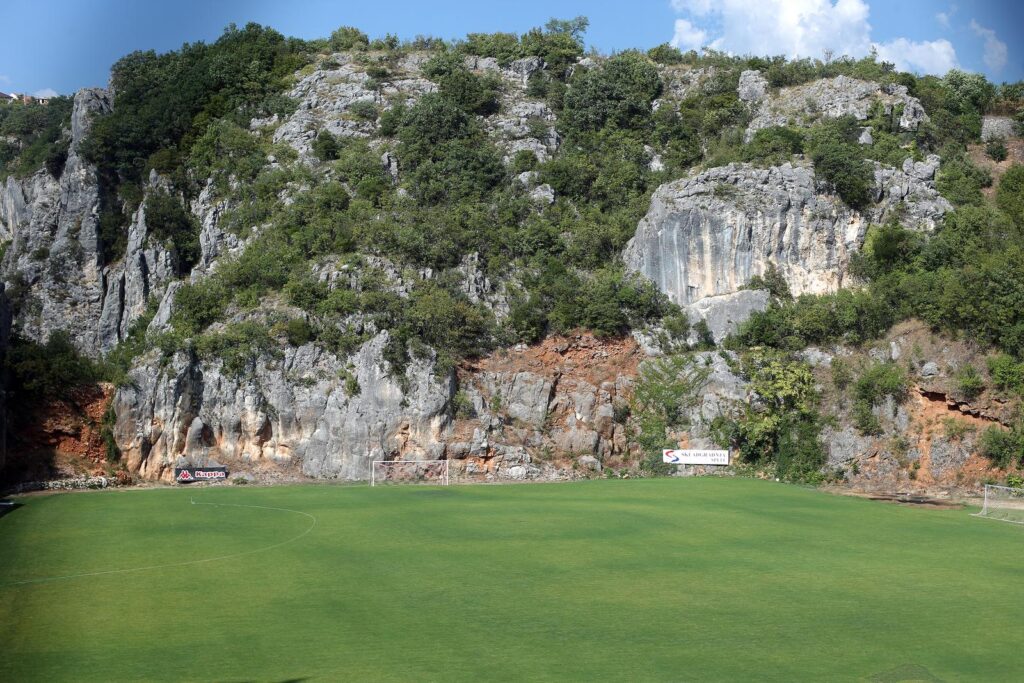
The Croatian football stadium once hailed as the most beautiful in the world is located at the foot of the imposing Topana fortress. Following liberation from the Ottomans, the cannon range from Topana determined the border between the Habsburg Monarchy and the Ottoman Empire. Today, it remains a sort of natural barrier that separates the aforementioned stadium from the beautiful Blue Lake.
In the past, there was a large natural sinkhole (funnel-shaped depression in the karst) on the site of today’s stadium, and at its bottom there was a meadow measuring 50 x 30 metres, where the locals planted vegetable crops. In 1974, at the initiative of the then sports workers from Imotski, preparations were initiated for the construction of a football pitch. Construction began a little later on in 1976, and although the hope was that the stadium would be ready by the 1979 Mediterranean Games in Split, it wasn’t actually completed until 1988.
As you might imagine, in order to safely build this football pitch, huge amounts of earth and stone had to be poured. The result of that is that today, the top of the stadium is 43 metres taller than the former lowest point of the sinkhole. The project for Gospin dolac was created as a graduation thesis at the Faculty of Architecture in Zagreb. Its author was Ivo Žarko, and the mentor was Goran Rako, an architect and professor at the aforementioned faculty.
Incidentally, NK Imotski, the longest-running Croatian second division team, was founded on Easter itself, more specifically on March the 31st, 1991. That was also the tragic day that Josip Jović died in Plitvice. He was the first Croatian policeman to lose his life in the Homeland War. Many famous Croatian footballers have also passed through the club’s junior selections, Ante Rebić, silver medalist at the 2018 World Cup in Russia, as well as Kristijan Jakić, bronze medalist at the 2022 World Cup in Qatar.