
April the 3rd, 2026 – Many tourists photograph him, pose under him, and plaster him all over social media, but few actually know the name of Ban Josip Jelačić’s faithful horse in the middle of Zagreb’s main square.
As Putni kofer writes, Zagreb’s story is a long and turbulent one, full of history, packed with rich cultural heritage, old streets, and a mix of brutalist, socialist, Austro-Hungarian and modern architecture at every turn. One of its most visited, most photographed and most beautiful attractions is certainly the main square – Ban Josip Jelačić Square – which was once called Harmica.
Today, it delights all of its many visitors with its gritty charm. It is adorned with several beautiful, historic buildings, the Manduševac fountain, and of course, the famous statue of Ban Josip Jelačić. This statue is found in countless photographs, but few actually know the real name of Ban Josip Jelačić’s horse.
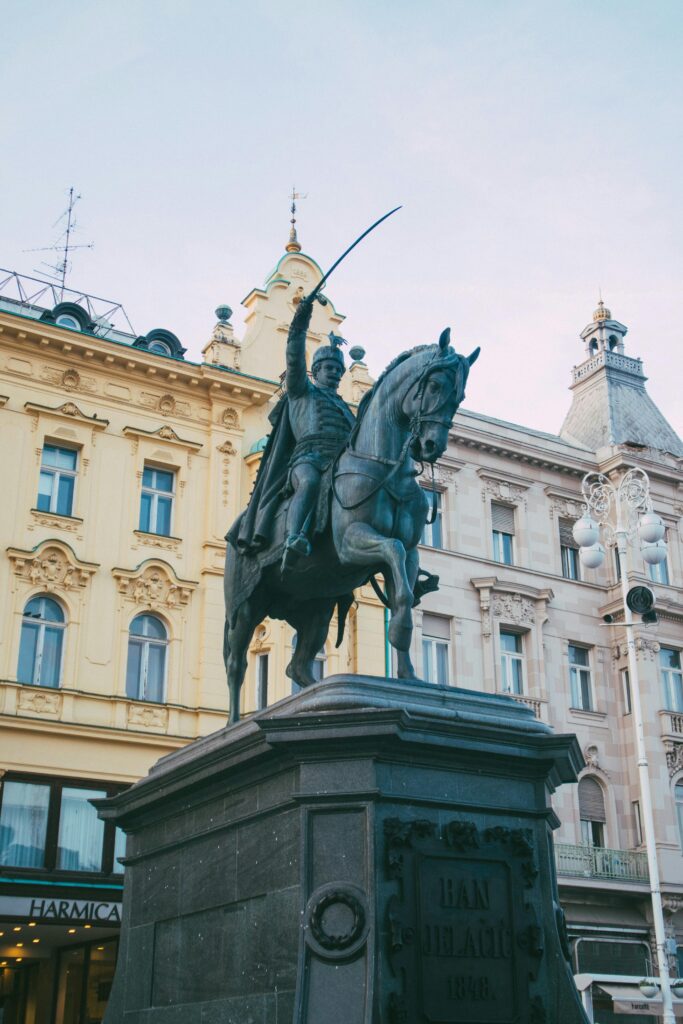
The statue that adorns the main square in Zagreb was ceremonially unveiled on December the 16th, 1866. It depicts the famous viceroy on horseback with a raised sabre held in his right hand. Jelačić’s horse was named Emir, and was a gift from Mahmud-beg Bašić from Bihać in Bosnia and Herzegovina. Jelačić rode Emir all the way to Zagreb for his enthronement, and later on into what is now Hungary.
The statue was erected only seven years after Jelačić died. It was initially oriented north, towards Hungary, whose revolution the ban suppressed in 1848. Although the original position had symbolic meaning for many, official city documents record that it was oriented towards the then “livelier and larger part of the city”. Today, both the viceroy and his loyal horse “look” towards the south side of the city.
The bronze monument dedicated to Ban Josip Jelačić is the work of Anton Dominik Fernkorn, a famous Austrian sculptor who also created the statue of St. George slaying the dragon (now located next to the Croatian National Theatre building) and the statue of the Blessed Virgin Mary above the fountain in front of the cathedral.

The unveiling ceremony of the monument to Ban Jelačić was recorded in a photograph by Franjo Pommer, which is widely considered the first reportage photograph in Croatian history. The statue was removed in 1947, only being returned to the square in 1990.
Today, Ban Josip Jelačić Square is a meeting place for visitors and residents alike, a starting point for exploring the city, and a symbol of the everyday life of Zagreb. It is at the “horse” (and the clock) that meetings have always been arranged, and walks through Ilica, Dolac, or the charming Upper Town begin. While passersby may rarely think about this horse’s actual name, Emir and his master still stand in the beating heart of the city, bearing witness to the endless passing of time and the stories that are constantly being created around them.