February the 16th, 2026 – The southern Croatian coast is often cited to be pure paradise, but did you know you can visit hell on Earth not far from Dubrovnik?
As Putni kofer/Martina Hrupic writes, seen from a distance, they look like a rocky string of pearls. Some would say that they are. They’re a beautiful jewel that adorns the sea in front of one of the most famous cities in the world, Dubrovnik. They’re called Grebeni, a place surrounded by beauty, as well as by a wild sea that can and has caused tremendous damage. Who would have thought that hell on Earth could ever be anywhere near somewhere as magical as Dubrovnik?
little, but part of something much bigger…
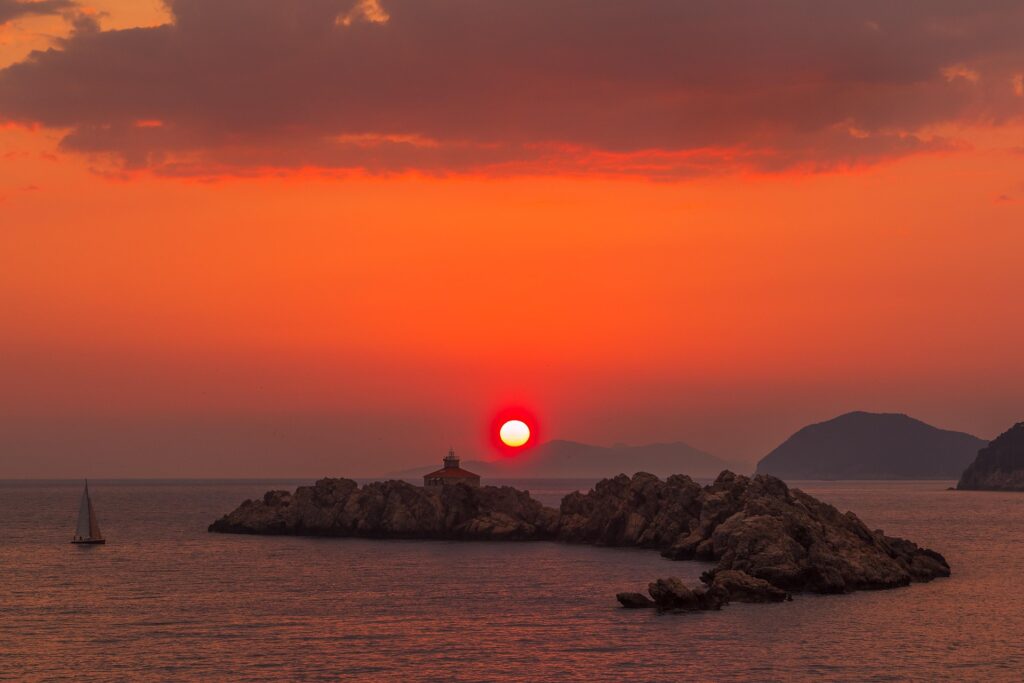
Let’s start from the beginning, and that would be the definition of these rocky outcrops. The so-called Grebeni are a small group of islets that are strung together near Dubrovnik’s Lapad peninsula. They consist of three islets, namely Greben, Kantenari and Vješala. A little further east lies another rock called Jabuka, or Apple, the namesake of the furthest flung Croatian island of all.
If you look at their composition and position, they’re essentially part of a larger island entity. They’re the remains of a reef that was once connected to Lapad and the islands in front of Cavtat a very, very long time ago. Geographically speaking, the Grebeni belongs to the larger Elaphite archipelago which lies northwest of Dubrovnik.
However, the Grebeni aren’t just grey rocks like any other rising from the sea. The “Hridi Grebeni” lighthouse was built on the island of Greben back in 1872. Although it’s now automated, it still shows sailors the way they need to go today, and is located on the top of the islet, more specifically on the eastern side of the Velika vrata entrance, west of the Port of Dubrovnik. It consists of a square, 13-metre-high stone tower and a single-story building spanning a total area of 140 square metres. It also includes a pier, and today it can even be rented out for ultra-private accommodation.
croatia’s first ever unmanned lighthouse
Much like the rocks themselves, this particular lighthouse is special. It was actually the first lighthouse in all of Croatia to be “unmanned”, or rather, without a lighthouse keeper. It was abandoned not long after World War II.
The Grebeni are quite alluring in terms of diving. This is primarily because there are many old shipwrecks in the sea surrounding them. Many divers go searching for the (thus far elusive) remains of a smaller ship that once transported gold from Dubrovnik across the Adriatic and up to Venice.
dubrovnik and hell on earth, who would think it?
The Grebeni have always been close to Dubrovnik, at least physically, and yet so far away because of the harshness of their wild nature. When we look towards these rocks from Dubrovnik, far out at sea we will see another island, Sv. Andrija, which is much more “tame”. A mere observer would never be able to conclude on their own just how utterly different these two islets and lighthouses really are. One is heaven, and the other is, as stated, known by many as Dubrovnik’s very own hell on earth. They have always been known as extremely dangerous.
They also weave a very interesting story, referring to testimonies from the book Legends of Light written by Jurica Gašpar. They tell the story of the lighthouse keeper who lived in that lighthouse with his family, and who was ultimately one of the actors in the events that resulted in the lighthouse being abandoned…
nature is always the boss, no matter how thick your walls…
The former lighthouse keeper was left alone at the lighthouse because his wife and child had gone into town to see a doctor. He had a sleepless night ahead of him, Jurica’s book states. “I guess the house will manage to hold out tonight, because I can’t sleep…” he wrote that day back in 1957. The south wind was getting stronger and stronger, and dark clouds covered the whole sky. What can still be witnessed on and around the Grebeni today was brewing: the sea was raging, swallowing and ripping apart everything in front of it.
“He didn’t like hearing the crashing of the sea out in the yard, and before long, the waves had already started to lap against the house. They must have been over 10 metres high, he thought. At that moment, he heard a loud crash which filled him with fear, so he ran up the hill because his instinct told him to head straight for the tower. He stayed in the tower all night and only the next day did the wind strength decrease, and only then could he actually consider going back down.
Eyewitnesses claim that the lighthouse keeper turned grey with fear that fateful night. In the end, it turned out that a wave at least 15 metres high had thrown a rock weighing several hundred kilograms into the house through a window, and it had even shattered the walls which were at the very least a whole metre thick. In order to get it out of the lighthouse, they had to break it into pieces.