
September the 21st, 2026 – There’s a brewery that survived the crash, WWII and privatisation, they even managed to continue when Zagreb ran out of beer.
Back at the end of the 19th century, when craftsmen could no longer produce enough beer for the thirsty Zagreb market, a large brewery was built in Črnomerec. Dubravko Grakalic reports for Index that Zagrebačka pivovara, known for its lagers, has since grown into a symbol of Zagreb and one of the best-known Croatian companies. “The idea of founding a large brewery in Zagreb arose in the circle of the Croatian Discount Bank when Gustav Pongratz entered its management board in 1890 and around the middle of 1892 Baron Petar Dragutin Turković,” historian Mila Kolar-Dimitrijević notes in the expert article “Zagrebačka pivovara until 1945” published in the Journal of Contemporary History in 1992.
“The bank’s director from its beginning, Franjo Šverljuga, convened the founding assembly of Zagrebačka pivovara in the bank’s premises on 19 May 1892, and already on 26 May the city authorities issued the permit, on the basis of which it was entered in the register of companies of the Court Table on 4 June of the same year, with a capital of 300,000 forints, or 1,500 issued shares of 200 forints each,” Kolar-Dimitrijević adds.
origins from the zagreb industrial zone
Beer production in Zagreb, which dates from the 14th century, before that major business decision was based on smaller breweries. The best-known one was opened in 1850 on the Upper Town, in today’s Gjure Basariček Street, which was called Pivarska Street. Later the plant moved to the corner of Gajeva and Teslina streets. Zagrebačka pivovara was built in the then industrial zone in the western part of the city, where several other significant factories were located. “There the concentration of industry was noticeable from the 1870s, and the intensity grew towards the end of the 19th century. North of the railway line, along the eastern side of the street that led from the City Waterworks plant (1878) towards Ilica (Vodovodna Street), there was a parquet and furniture factory (1873), and opposite it the coffee-substitute factory of Hinko Franck and Sons (1892) was built.
Not far from the intersection of Vodovodna Street with Ilica the Zagreb Joint-Stock Brewery and Malt Factory (1892) operated,” Goran Arčabić from the Zagreb City Museum tells Index.
back to november 1892…
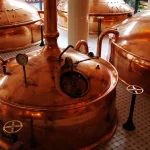
Contemporary Zagreb newspapers wrote extensively about the construction and opening of the brewery in Črnomerec. Narodne novine in November 1892 announced the construction of a large brewery in Zagreb: “The street façade of the main building, which will stand on the corner, will be 100 metres long in both streets. It will contain the brewing plant, malt house, fermenting plant and various necessary rooms for preparation. In addition a special building for apartments and offices will be built. The main building for brewing beer will be connected by an underground corridor with a large cellar in which the beer will mature.”
“Next to the large building where the beer will be served there will be a large garden that will be able to hold up to 1,500 guests, and that garden will be expanded for large celebrations, concerts and entertainments so that up to 5,000 people will be able to find places. In the immediate vicinity of the large ice-houses a fishpond will be arranged, about one jutro in size, from which the brewery will obtain the necessary ice, and which will also be able to be used as a skating rink,” Narodne novine published.
the trams ran until 02:00!
The skating rink was never opened, but the Zagrebačka pivovara restaurant was for decades a cult place in that part of the city.
The daily Obzor on the 13th of July 1893 reported on the opening: “Yesterday afternoon the new brewery was opened in a solemn manner. All afternoon, and especially towards evening, countless tram cars carried the public to the new brewery. The spacious garden, one of the largest in Zagreb, was packed with citizens from all strata of the capital. Towards evening there was such a rush of the public that much effort was needed to get to a glass of beer, because dense crowds surrounded the places where the beer was being poured. In the evening there were thousands of people in the garden, and the total attendance from 2 p.m. to two o’clock at night is calculated at more than 8,000 people.”
the brewery was saved at the last minute
The business of Zagrebačka pivovara in the first years was not positive because of strong competition – at that time about fifteen breweries operated in Croatia along with imported Austrian products – so in 1910 it came to the brink of ruin. Nevertheless, the unification of capital with the breweries from Sisak and Nova Gradiška saved the business. Then the management-ownership structure also changed, in which the main role was taken by industrialist Samuel David Alexander, owner of an oil mill and grain trader. Alexander modernised the brewery, connected it by rail to today’s Western Station and cheapened production. After the First World War, the brewery continued to operate successfully, opened a plant in Sarajevo, took over the brewery in Karlovac and significantly expanded the market to Dalmatia after the opening of the new railway line to Split in 1925.
escape from the ustaše…
In the 1930s Zagrebačka pivovara barely survived by selling real estate because of the great economic crisis, but that was only a prelude to greater troubles. “The authorities of the Banovina of Croatia had a negative attitude towards Jews, and a regulation was passed that they could not engage in the production and sale of food. A commissioner of the Banovina authorities, Vladimir Božić, was appointed to Zagrebačka pivovara, and at the annual assembly on 13 December 1940 Dr Božidar Alexander also resigned from membership of the management board, while Samuel David Alexander, together with his wife Ema, daughter of the prominent businessman Neuman, tried by converting to the Catholic faith to save at least their lives if not already their property,” historian Mila Kolar-Dimitrijević writes.
After the establishment of the Independent State of Croatia, the family was stripped of all property; Alexander himself took refuge from Ustaša persecution in the sanatorium of Dr Đuro Vranešić on Zelengaj, where he died in March 1943, while part of his family was killed in Ustaša camps and part survived by fleeing to the Partisans and abroad. The Ustaša authorities privatised the factory. In 1944 it ceased operations because of a lack of raw materials, which lasted until the liberation of Zagreb in May 1945. Zagrebačka pivovara was then taken over by the National Administration of People’s Property, which appointed its commissioner with the task of putting the brewery back into operation.
from 1945 to the present day
From then on Zagrebačka pivovara developed strongly – production of 60,000 hectolitres in 1952 rose to a million hectolitres in 1969. Sales were increased by the merger of trading companies from Bjelovar, Koprivnica, Našice and Labin, and by the opening of representative offices throughout Croatia and Bosnia and Herzegovina. The Lika Brewery Otočac was merged in 1971 and ceased operations in 1996. At that time the breweries in Daruvar and Karlovac also operated within Zagrebačke pivovare, and the company employed 1,600 workers. At that time, through the then model of socialist associated labour (SOUR), within the single enterprise “Zagrebačke pivovare” the plants in Zagreb, Karlovac, Daruvar and Otočac operated together, so today’s fierce market rivals were for years under the same roof.
they produced over half the beer in the former sr of croatia
Until 1970 Zagrebačka pivovara produced more than fifty percent of the beer in the territory of the then SR of Croatia, after which production fell to thirty percent by 1990. In 1993 the company was sold to the Belgian Interbrew. After a series of global ownership restructurings, Zagrebačka pivovara became part of the North American group Molson Coors in 2012, one of the largest brewing giants in the world. It produces 1,500,000 hectolitres of beer annually and employs around 650 workers. “Being one of the economic and industrial symbols of Zagreb is for us first of all a responsibility. We must preserve the best from the tradition we have inherited, but at the same time invest in people, technology and more sustainable production,” they say for Index from this important company whose products are advertised as “the law” for beer drinkers.