August the 28th, 2026 – Turning the clock back to August 1995, and the Croatian Freedom Train which finally set off from Zagreb to Split, making a journey that was inconceivable just weeks before.
Just after the end of Operation Storm (Oluja), more specifically on the 26th of August 1995, a train departed from Zagreb’s Main Station the likes of which had not been able to run through Croatia for years. Index reports that the final destination was Split, and the route led via Knin and parts of the country where railway traffic had been interrupted since the beginning of the war.
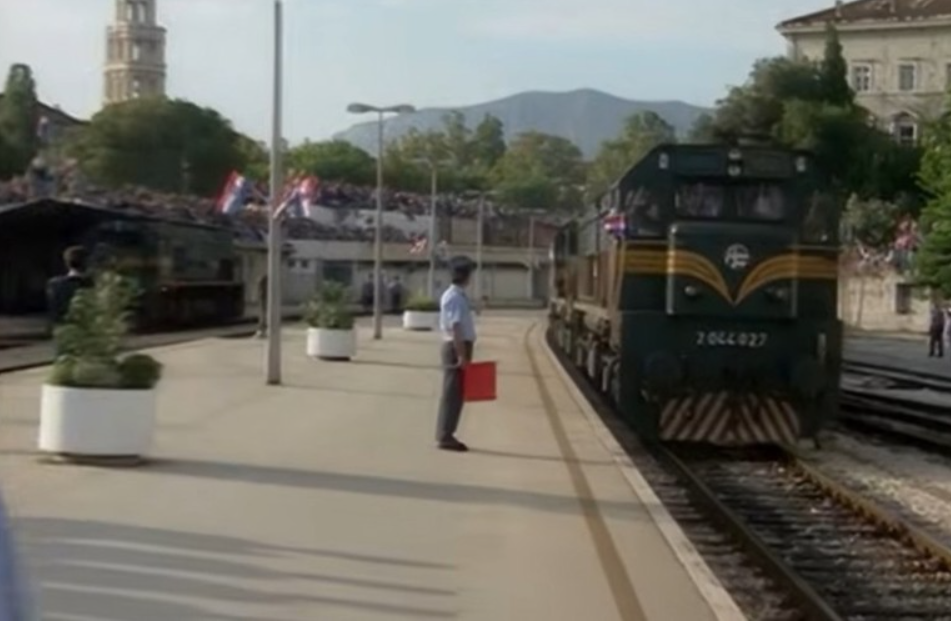
It was named the Croatian Freedom Train, and its journey was not conceived merely as the reopening of a railway connection. In a political and symbolic sense, it represented a demonstration that Croatia’s north and south were once again linked by land after Operation Storm. The train left Zagreb at 08:07. It carried around 700 passengers, including President Franjo Tuđman, members of the state leadership, politicians, military officials, cultural and public figures, singers, actors, refugees and numerous other guests. The 21-carriage composition was pulled by two diesel locomotives.
this train line had been out of function for over 4 years
Special importance was given to the entire event by the Lika railway line. The railway connection between Zagreb and Split via Knin had been interrupted for more than four years because of the war and the occupation of part of Croatian territory. After Operation Storm, railway workers and the army were given the demanding task of restoring the line in a very short time. In some sections the area was mined, signalling and safety systems had been destroyed, and stations and other infrastructure had been damaged.
Despite this, the line was made ready for the special train only a few weeks after the end of the operation. Because of the state of the infrastructure, preparing the journey was demanding, especially since the train was carrying almost the entire state leadership of the time. The journey lasted nearly the whole day. The train stopped in Karlovac, Gospić and Knin, and along the route it was welcomed by everyone it passed.
knin – the most important and poignant stop of all
The central moment of the journey was of course, the train’s arrival in Knin. The town had been placed back under Croatian control only three weeks earlier, on the 5th of August during Operation Storm, after having been the political centre of the self-proclaimed Republic of Serbian Krajina since back in 1991. At Knin station Tuđman delivered a speech in which he gave the train’s arrival a far broader meaning than simply the restoration of railway traffic. He spoke of Knin as a key symbol of Croatian statehood and claimed that by liberating the town the future of independent Croatia had been secured.
The entire event took place in an atmosphere of strong victorious sentiment after Operation Storm. Thus, the Croatian Freedom Train symbolised for the Croatian authorities and a large part of the public the end of years of occupation and the re-connection of the country.
at 18:11, the croatian freedom train finally arrived in split
After Knin, the train continued towards coastal Dalmatia. It arrived at Split station at 18:11, a little more than ten hours after leaving Zagreb. A large welcome was organised there, after which President Franjo Tuđman delivered another speech. He recalled that he had earlier promised he would come to Split by train from Zagreb. At one point the crowd began chanting “Vukovar”, which at that time was still not under Croatian control. Tuđman replied that Croatia still had to regain Vukovar, eastern Slavonia and Baranja, and expressed the hope that this would be achieved by peaceful means. That is exactly what eventually happened. The Erdut Agreement was signed a few months later, in November 1995, and the Croatian Danube region was gradually returned to Croatia’s constitutional and legal order through the process of peaceful reintegration, completed at the beginning of 1998.
a symbolic journey of a reconnected croatia
The Freedom Train has remained one of the more striking images of Croatia from the summer of 1995. Its practical significance was obvious: the railway link between Zagreb and Split via Knin was operating again after more than four years. It was precisely the symbolism that is the reason the journey is remembered three decades later. The train that left Zagreb that morning passed through an area where fierce fighting had been taking place only a few weeks earlier. Ten hours later it arrived in Split. Croatia thereby wished to send a very simple message: the territory that for years had cut the country in two no longer divided it.