August the 6th, 2026 – Đurđenovac is a small, overlooked Croatian town that not only used to have almost 600 kilometres of railway tracks, but was once a European industrial giant.
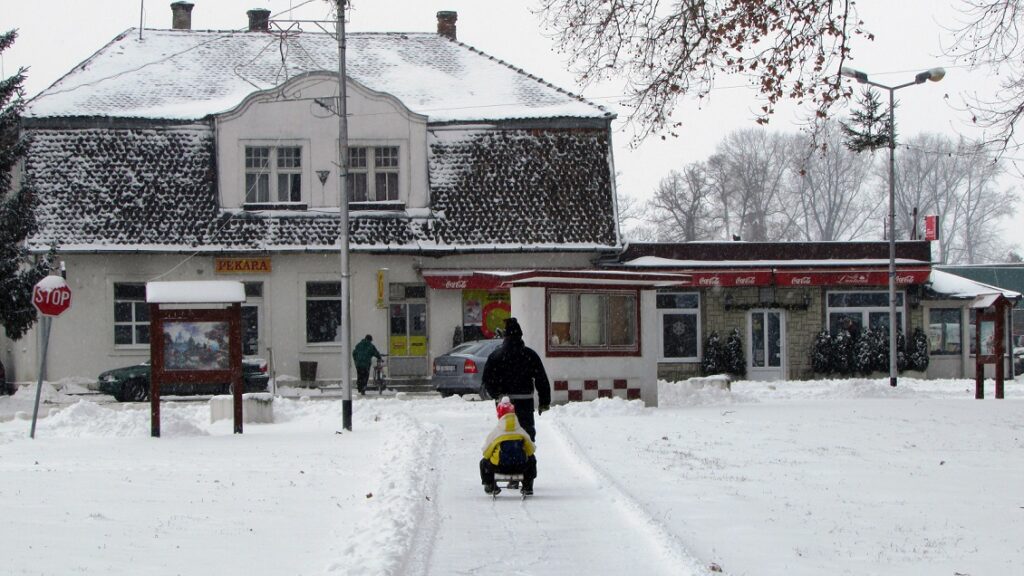
Situated far from anywhere that often ever gets a mention, Đurđenovac isn’t somewhere splashed across the glossy pages of travel mags. Turning the pages of the history book back, however, we’ll see that it was once booming. It actually grew alongside a sawmill and a tannin factory, gained workers’ colonies, schools and a kindergarten, and became the first electrified place in all of Slavonia.
If you walk through Đurđenovac today, Putni kofer reveals that you’ll mostly hear little else other than birdsong and the occasional passing car. About a hundred years ago, however, the sounds there were completely different. Through the dense old forests around the town, locomotives rumbled day and night, hauling logs to a factory that was one of the strongest industrial hearts of this part of Europe. According to publicly available data from the Croatian Technical Encyclopaedia, in 1929 the factory in Đurđenovac operated a narrow-gauge forest railway an astonishing 582 kilometres long. To put that in perspective, it is roughly the same as the straight-line distance from Zagreb to Sarajevo and back. Along that network ran a whole small army of trains, and the local company’s rolling stock numbered 61 locomotives and as many as 2,800 wagons.
it all began with a businessman from austria…
To understand all this better, we have to go back to the distant year of 1866, when the Viennese entrepreneur Josip Pfeiffer, after reaching an agreement with the landowner Ladislav Pejačević on the exploitation of the forests, built a steam sawmill in Đurđenovac. Over several decades and several changes of ownership, a tannin factory (a substance essential for leather processing) was added to the sawmill in 1889. From 1895 the company operated as Neuschloß’s Našice Tannin Factory and Steam Sawmill, later known simply as Našička.
As the factory eventually grew, so did the town around it. Đurđenovac developed into a purpose-built industrial town with workers’ colonies, schools, a post office, a kindergarten and a workers’ club. It was so far ahead of its time that it became the first electrified place in Slavonia. In as early as 1891, the factory received electric lighting, and by 1917, electricity had reached every apartment in the town.
Hundreds of kilometres of track led deep into Papuk and Krndija
All of this needed to be fed with wood, almost constantly, and in enormous quantities. That’s why, in parallel with the factory, a narrow-gauge railway developed that pushed out from Đurđenovac deep into the surrounding forests of Papuk, Krndija and beyond. The little trains climbed the slopes, hauled logs to the sawmill and tannin works, and then returned empty for a new load. Year after year the network was extended until by 1929 it had grown to the aforementioned 582 kilometres.
At that time the company was part of a holding with its headquarters in Geneva, with branches in Romania, Czechoslovakia, Hungary and Austria, and offices in Belgrade, Sombor, Rijeka, Zurich and Milan. In its best days, up to the Second World War, more than 10,000 people worked for the firm as a whole, of whom around 1,400 were in Đurđenovac itself. For a Slavonia town, those numbers sound almost unreal today.
an entire railway system simply vanished…
“Everything that grows must one day stop,” says an old folk saying. In the middle of the twentieth century, trucks increasingly took over the transport of wood from the forests; they were faster and cheaper than tracks that needed constant maintenance. Forest railways thus gradually lost their purpose, and those in and around Đurđenovac were dismantled during the 1960s. Rails and sleepers were pulled out of the ground, and many of the old alignments were turned into the roads we drive on today, often without realising that a locomotive once ran there.
After the Second World War the company operated under various names, first as the Tannin Factory and Steam Sawmill, then as DIP, and finally as DIK Đurđenovac. It ran into business difficulties at the beginning of the 1990s, and bankruptcy was declared back in 1994. DIK ceased operations in 2007, although some successors continued wood processing in parts of the former facilities. The cultural-historical complex of Đurđenovac is today protected and entered in the Register of Cultural Goods of the Republic of Croatia.