September the 7th, 2026 – Turning the clock all the way back to the 7th of September 1566, and we meet the famed Nikola Šubić Zrinski, the Croat who stopped 100,000 Ottomans, but lost his life during the final charge.
Nikola Šubić Zrinski was a Croatian nobleman, ban (viceroy) and soldier who lived during the 16th century and is remembered as a defender of Christianity throughout Europe. Index writes that he is best known for the Battle of Szigetvár, in which the sultan himself also lost his life. In Croatia, he holds additional importance because he elevated the Zrinski noble family to the status of the most powerful Croatian family of all.
he never shied away from battling the fearsome ottoman forces
He was born sometime during 1508. We don’t know exactly where he entered the world, but we know he had five brothers and sisters. His father was Nikola Šubić and his mother Jelena Karlović. Nikola’s political activity did not come only from the fact that he was a nobleman; the Karlović family had a long tradition of state functions. Nikola’s uncle Ivan Karlović later served as ban. The brave Zrinski was primarily a soldier. After finishing military school, Šubić joined the ongoing war and defended Vienna in 1529, at which time he was noticed by many nobles and military officials. After the siege he was rewarded with a golden chain and received a horse.
The conflict with the Ottomans only continued. When he inherited the estate in the Una valley in 1534, he also inherited the obligation to pay tribute to the Ottomans. Nikola truly did not want to pay tribute to the enemy, so he provoked a conflict over the fortress of Dubica in order to justify not paying the taxes.
habsburg or zapolya?
At the same time the Kingdom of Hungary was very unstable. After the death of Vladislav II Jagiellon at Mohács, the whole country split into two camps: one favoured the Habsburgs and wanted to bring them to power in Hungary and Croatia, while the other favoured the local Hungarian nobleman John Zápolya. Nikola Šubić Zrinski considered Ferdinand Habsburg the better and wiser choice, and he had already become acquainted with the Habsburgs during the siege of Vienna. That is why, on his own initiative, he decided to kill the nobleman Johann Katzianer, who had rejected the Habsburgs and sworn loyalty to Zápolya. He captured Katzianer’s fortress of Kostajnica, but soon handed it over to the Ottomans, from whom he expected retaliation for refusing to pay tribute.
the zrinskis head north…
From the 1540s on, he was given administration of the whole of Međimurje. He soon moved there, renovated the castle in Čakovec, and after a few years received the right to collect taxes himself and to settle serfs in the area. At the same time he became Ban of Croatia, a title he held until 1556. He left the “office” of ban because he was dissatisfied that he had failed to raise more funds for the fight against the Ottomans. He wanted someone more capable to take the position while he continued to wage war against the enemy. He immediately received the position of treasurer in Hungary (Hungarian nobles were inclined to give him whatever he wanted because he was highly respected even before Szigetvár) and fought the Ottomans twice. He believed he already knew their strategies well and rushed into war with them whenever possible.
the famous battle of Szigetvár
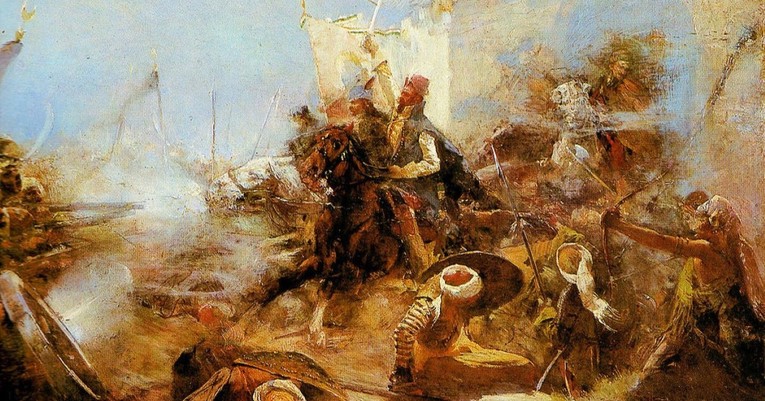
The next opportunity presented itself in 1566 when he was staying in the fortress of Szigetvár. Szigetvár is located in Hungary on the shortest route to Vienna. Suleiman the Magnificent led 100,000 men to capture Szigetvár and begin a new siege of Vienna. To them Szigetvár was just another miserable Christian fortress; the Ottomans conquered such places every other day. However, Suleiman the Magnificent was not prepared for what was about to happen. Around 2,000 men, mostly ethnic Croats, decided that the Ottomans would not pass here. As soon as Ottoman infantry approached the gates of Szigetvár, the defenders threw everything they could at them and the enemy withdrew. Szigetvár was constantly bombarded with cannonballs for a full month, and one did not walk in the inner courtyard because of the arrows that fell into the fortress without stopping.
The defenders ate all the food they had, then began to eat their own horses. They maintained their morale largely thanks to Nikola Šubić, who in his classic style still saw only victory. Then came 7 September 1566, and it was clear that that morning the Ottomans would break into the town. Nikola put on a hat and noble attire, left his knight’s armour aside, took his father’s sabre and bravely led his men into the final episode of that nightmare. All the defenders died that morning, and the Ottomans achieved their goal.
an extremely costly goal
But the goal was achieved at too great a cost. The Ottoman army should not have lost a fifth of its force on some stupid and unimportant fortress, nor should it have been delayed there for half the summer. To make matters worse, during the siege Suleiman the Magnificent died, so the army’s morale was weak and worthless. The army was soon recalled and headed home. Nothing came of a new siege of Vienna. The heroic defence of Szigetvár was the main topic of conversation throughout Europe in the following months. Everyone spoke about Nikola Šubić: from Roman and Spanish diplomats who claimed that God had sent him to save Vienna from the Muslims, to the French Cardinal Richelieu who called him “the saviour of Europe and the Christian world.”
His descendants continued to act politically and hold various positions in the new state, the Habsburg Monarchy. Nikola elevated the Zrinskis from an ordinary noble family to the most important family in Croatia. Their influence would mark the following period, right up to the Zrinski-Frankopan conspiracy of 1671.
Nikola Šubić Zrinski remains incredibly relevant to this very day. Legends of his defence of Szigetvár were retold to children in the following centuries, and when the awakening of nationalism began in the 19th century, Nikola became even more popular. Then the 1880 earthquake struck Zagreb and the city had to be rebuilt. About a hundred metres southeast of Zagreb’s main square, construction began on the most beautiful park in the city centre. The park would be named Zrinjevac, or Nikola Šubić Zrinski Square, further immortalising him.