
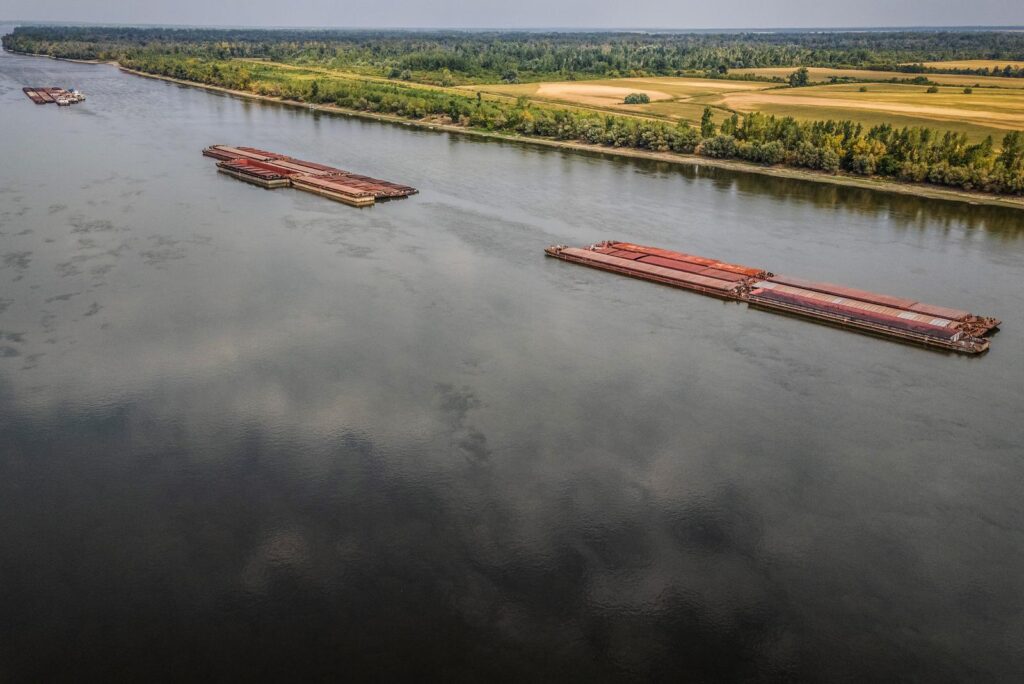
August the 13th, 2026 – The current Danube traffic collapse could end up stretching into autumn as contracts worth 800 million euros fail.
Convoys with goods are stuck in front of the Mohovo Channel upstream from Ilok and as many as 60 Danube voyages have been postponed. Marija Brnic reports for Poslovni that over recent days in Vukovar, all eyes have been firmly fixed only on the forecasts of the State Hydrometeorological Institute and the numbers on the local water gauge. Since measurements of the Danube water levels began, it has never been lower, and in recent days it has almost completely halted river traffic in Croatia’s largest river port.
For two weeks already there have been practically no berthings of cargo barges or tourist cruise ships, and the critical point is the Mohovo Channel near Šarengrad, where the depth of the fairway does not meet the minimum conditions for safe and financially viable transport.
The crisis is entering its third week, yet what is worrying is that there are no good news in sight for its end. For August it is certain that regular traffic will not resume, even if heavier rain falls, and concern is also growing about September and even October. The Port of Vukovar has already put forward the first estimates of possible losses.
the port of vukovar is struggling
One topic is how to close natural retention areas by installing weirs, and the other issue that needs to be opened is the cleaning of the Danube along its entire course. With partners, as company director Marijan Kuprešak explained, they had contracted the transhipment of around 200,000 tonnes of various goods over the next three months. At an average transhipment price of 4 euros per tonne, this means the collapse of valuable contracts and a loss of around 800,000 euros in revenue. The scale of the potential damage in such a worst-case scenario is illustrated by the fact that this is somewhat below the level of revenue the company achieved in previous years; last year it stood at 1.2 million euros.
This year was expected at the Port of Vukovar to be a year of recovery from the crisis the company has been going through, largely due to the war in Ukraine and the associated reduction in traffic. At the current depth of the Danube, ships have to sail with reduced capacity, and apart from meaning that more voyages are needed for the same quantity of cargo, there is also the risk of grounding or the cost of ships standing idle, which currently makes this form of goods transport uncompetitive.
Until now it was precisely the lower price that gave river transport an advantage over road or rail. Kuprešak says that truck transport, which users are largely opting for in such situations because of investments in the railway, is several times more expensive than river transport.
Business partners, Kuprešak says, still show understanding, but if the drought continues, because of the dynamics of their own contracts and deliveries they will be forced to divert cargo to trucks and trains, which will of course spill over further onto their costs and the final prices of products. According to available information, cruise ships are also not docking in Vukovar and around 60 contracted voyages have been cancelled, mostly from Germany, for which the paid money has been refunded. The companies have suffered a loss of business of around one million euros per voyage.
Companies can as a rule recover any losses only through insurance companies, and even if a state of natural disaster were declared, previous practice shows that the state does not cover such damage outside the agricultural sector. However, Kuprešak says that at the level of shipowners, ports and landing stages of the countries all directly affected by the Danube water-level crisis, discussions are beginning about a possible initiative to seek assistance through horizontal support from the European Commission.
Non-repayable subsidies at that level would help, he says, to cover the losses that everyone will be hit by this year, but as climate change increasingly affects the European area and impacts rivers, an equally important issue that the state and the EU need to address is securing the navigability of the Danube. And that, Kuprešak says, is becoming increasingly threatened.
“One topic is how to close natural retention areas by installing weirs, and the other issue that needs to be opened is the cleaning of the Danube along its entire course,” Kuprešak stresses.
1 million euros in losses have been suffered by the companies that organise voyages on the Danube.
issues impacting croatia from germany to romania
In some countries, they have already carried out blasting and dredging to ensure passage at bottlenecks, but because of the extreme drought and record-low water levels, which appear to be becoming an increasingly pronounced problem in these areas, the issue will have to be approached more systematically and cover the entire course of the Danube, from Germany to Romania.
Blasting and the removal of underwater rock masses as well as deepening the riverbed is a permanent solution also for the Mohovo Channel, because it is the most sensitive point in the Croatian section of the Danube. For many Croatian companies the functioning of the Danube and the Port of Vukovar is an important business link, and among the users are numerous agro-combinates, producers of artificial fertilisers, cement and bulk cargo for the construction industry.
Until now the Danube was considered a navigable waterway 365 days a year, and a problem would at most appear because of ice in the winter months, but now the risk is becoming the summer period and drought. Shipowners, ports and landing stages therefore also see the historic drought affecting the Danube and river transport as an opportunity to sound the alarm in Brussels for the launch of a comprehensive, strategic regulation of the Danube and the permanent securing of its navigability.