November the 23rd, 2026 – Forest the size of 3,740 football pitches has completely disappeared across three Croatian nature parks.
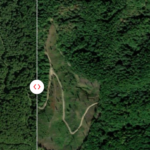
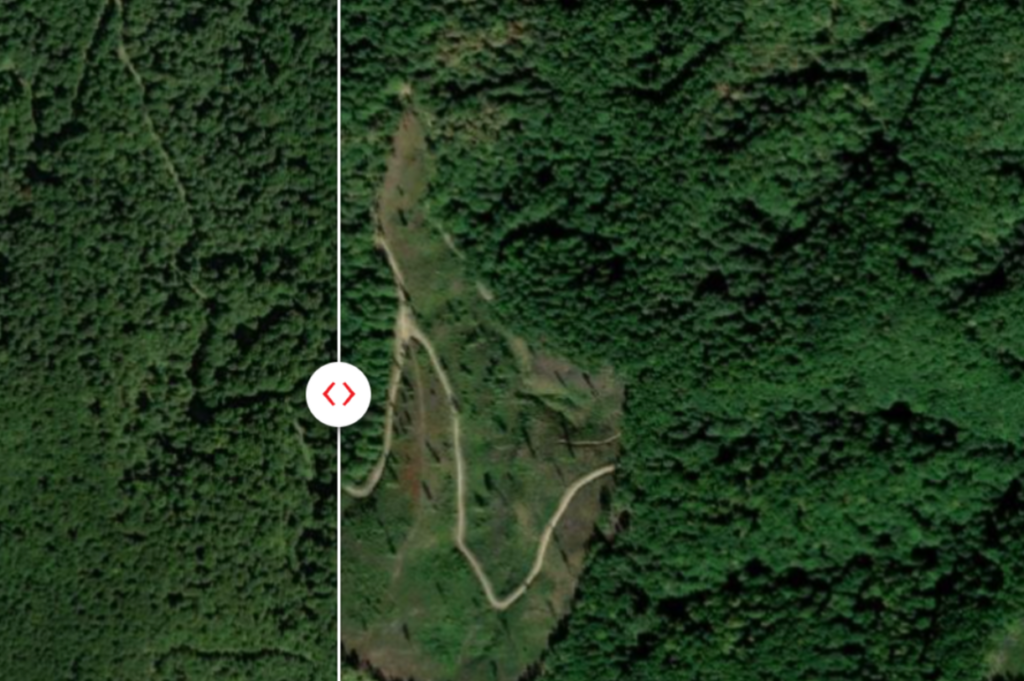
Zagreb-based programmer and entrepreneur Lada Kovjanić, who attracted public attention in early October with an interactive map of the disappearance of forest cover on Medvednica, has expanded her research to several other large forest areas in Croatia. Slobodan Muftic reports for Index that according to her new analyses published on the portal šume.eco, in the nature parks Lonjsko polje, Papuk and Kopački rit alone over the past decade or so, a reduction in tree crowns has been recorded on almost 2,700 hectares – an area corresponding to approximately 3,740 football pitches.
a new portal tracks changes to forested areas across croatia
“As I announced, I’ve opened a special portal that will over time enable insight into all larger forest areas throughout Croatia, with a particular emphasis on protected areas such as nature parks,” Kovjanić explained, adding that the changes indicated by her research are not necessarily the result of illegal logging. “I didn’t deal with questions of legality and justification, but exclusively with the change, i.e. the disappearance of forest cover for any reason over the past decade or so. I analyse satellite photographs during spring, when vegetation is at its densest, and compare them with previous years.”
The largest changes were recorded in Lonjsko polje Nature Park, where analysis of satellite images from the period from 2016 to 2026 established the complete or partial removal of tree crowns on as much as 1,246.09 hectares, or an area corresponding to 1,745 football pitches. This is an area known for valuable floodplain forests of pedunculate oak, ash and alder, which are among the most important natural assets of Lonjsko polje. Worrying proportions are also shown by the map of Papuk Nature Park, where between 2017 and 2026 a reduction in tree crowns was recorded on 914.68 hectares. In Kopački rit the analysis records 509 hectares, or 713 football pitches, fewer high tree crowns than back in 2017.
According to the data published by Kovjanić, in the area of Lonjsko polje, Papuk and Kopački rit alone a reduction in tree crowns was recorded on a total of 2,669.85 hectares, which corresponds to an area of approximately 3,740 football pitches.
“lonjsko polje has suffered the most”
“The purpose of this tool is to show on which cadastral parcels the greatest changes have occurred and to determine who manages that forest. Lonjsko polje has suffered the most. There is quite a lot of clear-cutting, areas where there is no longer any forest, in Kopački rit and Papuk. A lot was damaged in storms and due to disease, but logging is not negligible either,” Kovjanić explains. Her analysis is based on images from the European Sentinel-2 satellites, and only zones larger than 0.3 hectares (one hectare has 10,000 square metres) are included in the published total areas. Smaller changes and selective felling of individual trees therefore remain outside the display.
croatian forests claims there are serious shortcomings in interpreting the data
In their response to an enquiry sent to them about the mapping of Medvednica, where according to Lada Kovjanić’s analysis around 150 hectares of forest – an area larger than 206 football pitches – disappeared over nine years, Hrvatske šume (Croatian Forests) stated that there are “serious shortcomings in the interpretation of the published data.”
“Areas that were already arable land, agricultural land, urban areas or infrastructure facilities before 2000 have also been marked as lost forest. Likewise, the areas marked in red include parts of the surface where young forest is located, which is poorly visible on satellite images,” Hrvatske šume emphasise, adding that individual displays of open areas cannot automatically be interpreted as permanent forest loss. “I believe that transparency is in everyone’s interest and that is why I invite Hrvatske šume and all interested parties to cooperate. I think this technology could help introduce order into forest management, both of state and private forests,” says Kovjanić.
“old forests disappearing is particularly concerning”
“The trend of disappearance of forest cover, especially old forest with trees higher than 20 metres that takes more than a hundred years to regenerate, is quite worrying. Since 2001 Croatia has lost 85,983 hectares of old forest, or almost six percent of its total area. These are forests that will not regenerate in our lifetimes and this affects the entire ecosystem.” Official data shows that forest areas across Croatia are increasing. According to the results of the Second National Forest Inventory, presented in June this year, the area of forest land increased from 2.378 to 2.431 million hectares compared with the previous inventory, while the total growing stock decreased slightly, from 552 to 548 million cubic metres.
However, an increase in the area under forest does not necessarily mean that the area of old and ecologically valuable forests is also growing. Abandoned agricultural areas can grow into young forest or scrub, while the restoration of old forest habitats can take decades, and sometimes significantly longer.
might a third of mature croatian forest vanish?
Old trees have hollows, thick cracked bark and dead wood on which woodpeckers, owls, bats and rare insects such as the stag beetle and the oak longhorn beetle depend. Old and mature forest also protects soil and water and holds the most carbon. Such habitats form only after a hundred or more years, according to the šume.eco website.
It is important to emphasise that the recorded reduction in tree crowns does not automatically mean that the forest has disappeared forever on all those areas. Changes can be the result of regular forest management, storms, drought, disease, natural processes or other interventions. The maps primarily show where the forests have changed and enable the competent institutions and citizens to check what actually happened in those areas. If the felling of old forest continues at the same pace as in the past five years, by the end of the century a third of such forest that existed back in the year 2000 will disappear. According to Kovjanić’s additional analysis, on around 40 percent of the areas where a loss of high forest cover was recorded between 2001 and 2005, the tree crowns had still not reached a height of ten metres by 2020. This shows how long the recovery of high forest cover can take.