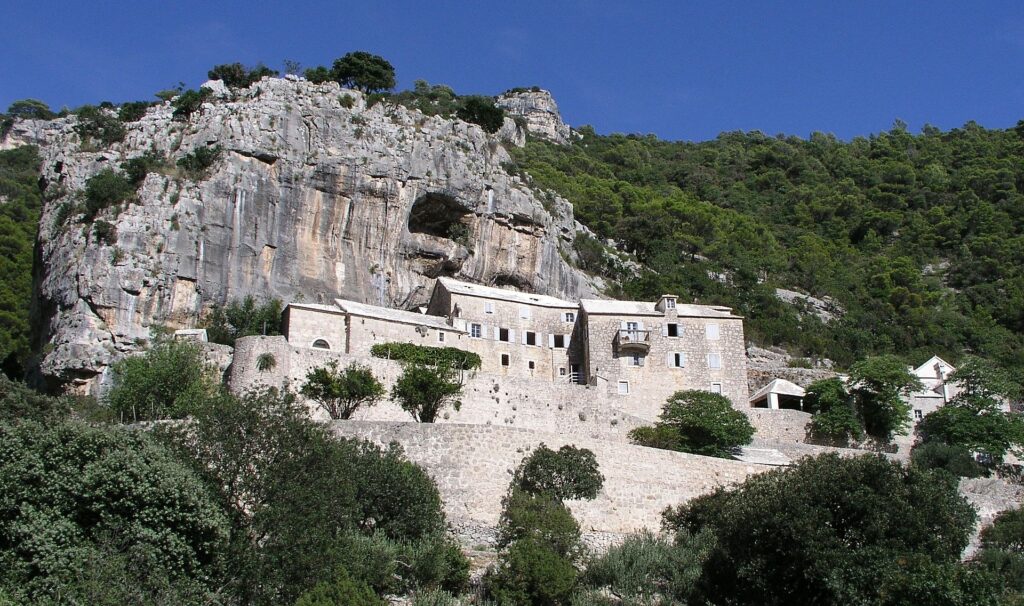
May the 20th, 2026 – The bizarre and eerily beautiful Blaca Hermitage on the island of Brač is impossible to reach by road, and it’s a settlement that was cut off from the world for a reason.
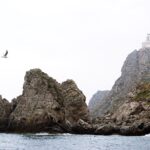
Hidden between the rugged, rocky cliffs and dramatic southern coastline of the island of Brač lies one of Croatia’s most unusual historical sites. Putni kofer writes that it’s an old, silent place so isolated that, until relatively recently, people there lived almost completely cut off from the rest of the island, let alone the rest of the world. Known as the Blaca Hermitage (Pustinja Blaca), it’s a truly remarkable complex was built over centuries by hermit monks who created a self-sufficient community in one of the harshest and most inaccessible landscapes on the entire Adriatic.
a “pustinja” that has absolutely nothing to do with a desert

Despite its name, the Blaca Hermitage has nothing to do with deserts in the traditional sense. The Croatian word pustinja in this context refers to a hermitage or isolated monastic settlement rather than sand dunes or barren wilderness. The settlement developed on the southern side of Brač beneath the slopes of Vidova Gora, between Bol and Milna, in an area surrounded by steep stone terrain and difficult coastal access.
the refuge of hermit priests on the run from the ottoman invaders

The origins of Blaca date all the way back to the 16th century, when Glagolitic priests fleeing Ottoman expansion sought refuge inside a cave known as Ljubitovica. Over time, they transformed this strange and totally isolated location into a surprisingly advanced settlement that included a monastery, residential buildings, agricultural structures, vineyards, olive groves and even an observatory. What makes the story particularly extraordinary is the environment itself. The monks managed to survive for centuries on difficult karst terrain with very limited access to the outside world, relying largely on their own labour, knowledge and the surrounding natural environment.
the coming together of religion and science

Blaca was not only a religious settlement, it also became an important scientific and intellectual centre. One of the most remarkable parts of the complex is its observatory, which reflected the monks’ deep interest in astronomy. Serious scientific observations were carried out there at a time when such research was rare in the region. The final hermit and administrator of the monastery, astronomer Don Nikola Miličević, maintained contact with European scientists, while his measurements and astronomical work gained international attention. Today, visitors can still see historical scientific instruments, including a telescope, alongside preserved personal items from the monastery’s final years.
Another hidden treasure of the weird and wonderful Blaca site is its library. The hermitage preserved hundreds of valuable books, manuscripts and documents covering theology, philosophy, astronomy and natural sciences. Many of the works arrived from across Europe, demonstrating the unexpectedly high intellectual level of the isolated community. The contrast between extreme physical isolation and strong scientific and educational ambition remains one of the most fascinating aspects of the site.
it remains as it was intended – hardly accessible
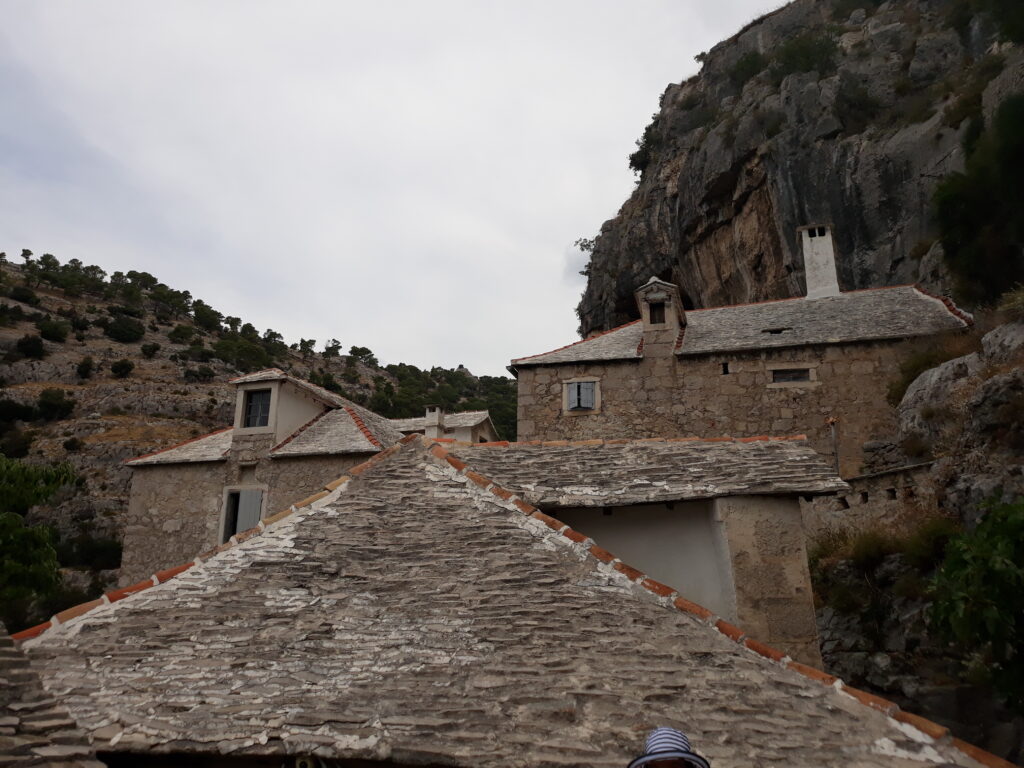
Part of what gives Blaca its unique atmosphere today is that it remains inaccessible by normal road access.
Visitors have no choice but to reach the site on foot. One route approaches from the sea through Blaca Bay and takes roughly 30 to 40 minutes depending on pace and conditions. Another route approaches from inland Brač, but even there, part of the journey must still be completed on foot after parking. That final walk through rocky Brač landscape helps visitors understand the scale of the challenge faced by the hermits who once lived there permanently. That goes without even mentioning the intense heat and the intolerable beating down of the Dalmatian sun for a large part of the year which would put anyone off attempting to reach it.
The Blaca Hermitage remained inhabited all the way until 1963, when Don Nikola Miličević, the very last hermit, passed away. Following his death, this incredible settlement was transformed into a museum and cultural monument. Today, it stands as one of Croatia’s most extraordinary historical sites, and a place where religion, science, survival and isolation intersected for more than four centuries. Perhaps most remarkably of all, even in modern Croatia, there is still no road leading directly to it. Most hope it remains that way forever.