June the 1st, 2026 – Kids playing in an old, dilapidated Croatian fortress isn’t a new sight anywhere in the country, but those same kids accidentally discovering a 500-year-old secret certainly is unusual. Few people know that on a raised plateau above the canyon near Benkovac lies the little-known Kličevica Fortress, which is connected to Leonardo da Vinci.
Benkovac is by far the largest city in Dalmatia by area, spanning a total area of 514.5 square kilometres. Located in Ravni kotari and the Dalmatian hinterland, Putni kofer writes that this old settlement encompasses a vast territory that includes numerous settlements, expansive fields, hilly areas, and rich cultural heritage. While it may seem unusual that a relatively small city by population occupies such a large area, the answer lies in its administrative structure. Benkovac includes a large number of suburban and rural settlements spread across a wide Dalmatian territory, making it the largest settlement in the entire region by area.
the home of one of the most impressive medieval ruins in the zadar hinterland
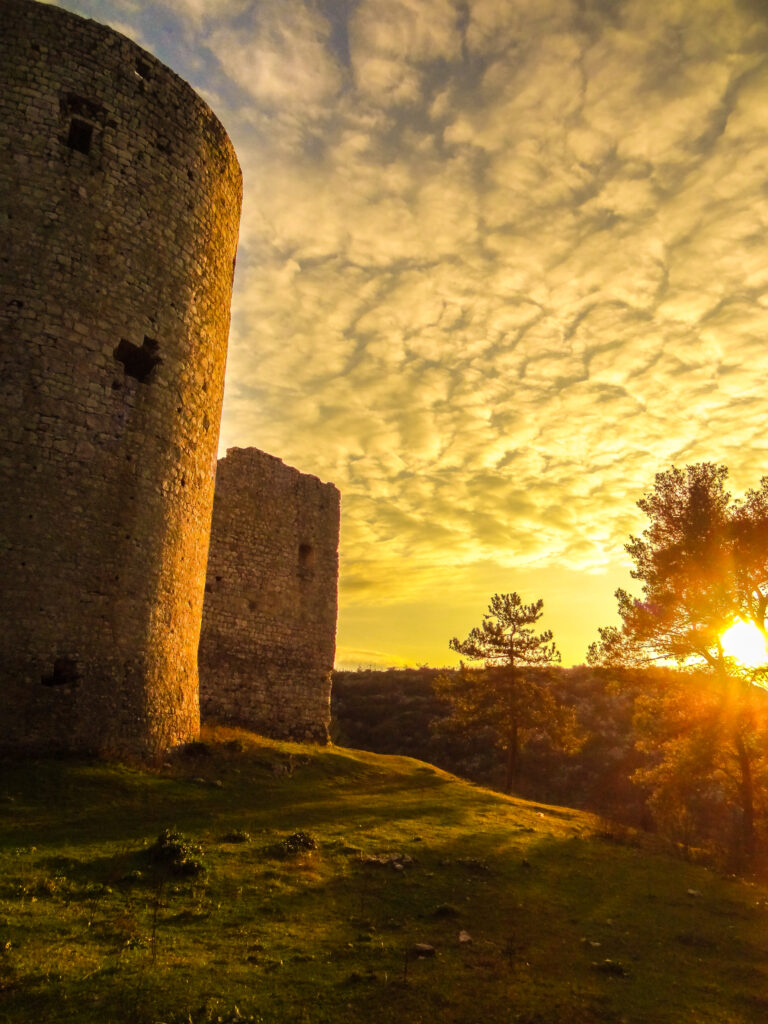
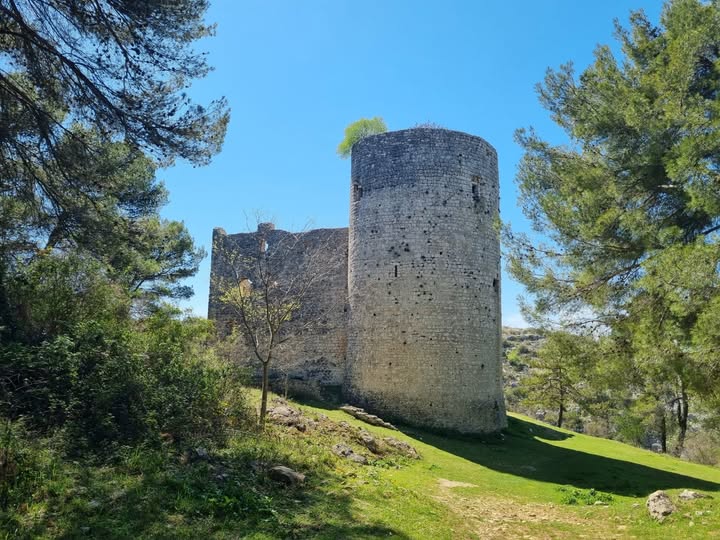
Now that we’ve realised we’ve been wrong our whole lives thinking Split was the largest, it’s time to start exploring this vast Benkovac area. Today we head to the village of Raštević. Above the natural canyon of the Kličevica River, on a raised plateau, stands the fortress of the same name, and that’s Utvrda Kličevica, or Kličevica Fortress, if you will.
This imposing old structure is one of the most impressive medieval ruins in the Zadar hinterland. It was built in the 15th century, most likely by the noble Kurjaković family, who belonged to the wider Gusić clan. The fortress was constructed from rough stone and featured prominent defensive walls and towers. Today it is partially preserved, and the layout of the space can still be clearly recognised, including the entrance, courtyard, and remains of fortification structures. Its position gives it a very dramatic and almost cinematic appearance, which is why it is often described as a Dalmatian “fantasy” castle.
the home of ancient secrets and one very special story…
A special story connected to this fortress is that it once guarded a bronze triple-barreled cannon that was confirmed to have been built according to a design by the one and only Leonardo da Vinci. According to reports, it is the only original of its kind in the world.
“The cannon was discovered four decades ago by schoolchildren who were playing in the old fortress, and it has now finally been confirmed that this 500-year-old weapon was made by the great artist and scientist.”
In the Codex Atlanticus, there is a drawing linked to the cannon from Kličevica. This codex is kept in the Ambrosiana Library in Milan and was created between 1478 and 1519. It is a large collection of sketches and notes by Leonardo da Vinci, including various weapon projects.
LEONARDO DA VINCI’S very own BRONZE CANNON
One of the drawings shows a triple-barreled cannon with barrels placed side by side, mounted on a wooden base with wheels. This exact arrangement of barrels and mobile construction is compared to the description of the Kličevica cannon. The idea behind such a weapon was that it would be lighter and more mobile, making it more practical for field use. A modern replica of this cannon, based on Leonardo’s sketch, is kept today in the Leonardo da Vinci Museum of Science and Technology in Milan.
The main role of Kličevica Fortress was defensive and supervisory, as it controlled important land routes between the interior and the coast during the period of frequent conflicts with the Ottoman Empire. Therefore, it is not surprising that such an important piece of weaponry was found at this location.
a mighty fORTRESS BUILT back during THE turbulent 15TH CENTURY
According to historical records, the start of the construction of Kličevica Fortress began in 1453 by Grgur, the son of Prince Tomislav Kurjaković. Since it was being built near the Venetian fortress in Vrana, the Venetians repeatedly tried to stop the works, viewing it as a threat to their control of the area that they considered so valuable at the time.
In 1463, the Venetian Empire’s authorities sent an official protest to the court of Matthias Corvinus requesting that construction be halted. The king accepted their request and ordered the works to stop. Despite this decision, the Kurjakovićs ignored it and continued construction during the 1470s and 1480s.
from promise to abandon and ruin
In addition to conflicts over the fortress itself, the second half of the century was marked by tensions involving the Morlach population, as well as robberies, violence, and abductions of subjects. With the Ottoman advance, mutual tensions gradually calmed, and after the defeat of the Croatian army at Krbava in 1493, the influence of the Krbava powers in Dalmatia eventually totally weakened.
In 1527, Kličevica Fortress fell under Ottoman rule along with a whole cascade of other fortresses and castles in the Croatian-Hungarian kingdom. In the 1550 census of the Klis Sanjak, it is mentioned that the fortress was already abandoned by then. Thanks to its isolated position, it has remained relatively well preserved in its original form.