
August the 26th, 2026 – Belišće isn’t a name you’ll likely have ever heard if you’re not from Croatia, but this Croatian town had an industrial empire grow out of it.
It’s also unusual because of the fact that it is one of the few Croatian towns whose beginning can be fixed almost like a date of birth. Putni kofer turns the hands of the clock back to the year 1884, and we find ourselves in a place with a pasture-and-arable clearing called Belistje. It sits just beside the banks of the Drava, and the reason a large sawmill that the Gutmann family builds there. Soon after, a railway, workers’ houses, a school, a post office, an electricity network and a water supply all arrive. In just a few decades, the industrial plant thus created an entire settlement around itself, and from it grew today’s town.
the family company that built an entire town
In 1884, two companies belonging to the Gutmann family from Velika Kanjiža bought from the Valpovo landowner the right to a ten-year use of a huge expanse of oak forests. They erected the sawmill on the Belistje clearing, after which the settlement later took its name. The Croatian Biographical Lexicon notes that the Gutmanns further expanded their business by purchasing forests from the Prandau family of Valpovo and that at the beginning of the 20th century they controlled massive swathes of of forest and land. From the very start Belišće was therefore tied to one of the most valuable resources of the area, Slavonian oak.
the biggest and most modern sawmill in europe
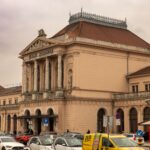
According to data from Belišće, the sawmill was one of the most modern of its time and probably the largest in Europe for cutting oak timber. Large-scale production also needed a good transport link, so already in 1884 the first kilometres of the forest-industrial railway were laid. Over time the network grew to 335 kilometres and developed into the Slavonia-Podravina Railway with public transport, a station, a locomotive shed and a workshop in Belišće. The Croatian Biographical Lexicon emphasises that this railway also carried passengers and thus compensated for the lack of state railways in this part of Slavonia.
Alongside the sawmill and the railway an industrial colony grew. Official sources state that the first residential houses were soon built and a fire brigade founded; in 1886 a school classroom and a post office were opened, and in 1890 a primary school was constructed. By 1892 the place already had an electricity network and a water supply with sewerage, which was still rare in the surrounding villages at that time. Development was also visible in the architecture. Next to the workers’ houses arose a house for the owners and offices, the officials’ social centre Casino, and in 1905 the Gutmann Palace, known in Belišće as Palej. Up to the First World War the workers’ settlement continued to expand, and some of its parts remained known by the names Five Stars, Green Houses, Mitrovica and Pekmez Street.
workers arrived from across the world
Industry drew workers from the Valpovo and Miholjac areas and from Lika, while specialists arrived from other parts of Austria-Hungary. Among them were many Germans, Hungarians and Czechs. With the newcomers cultural life also developed. The Rosenberg family arrived in 1888, and their son Sigmund spent part of his childhood precisely in Belišće. Later, in the United States under the name Sigmund Romberg, he became a well-known composer of operettas and musicals and dedicated the Belišće March to the place of his childhood.
By the time 1918 rolled around, the company moved its headquarters from Budapest to Belišće, and in 1927 the place became an independent municipality. After 1945 followed the period of the Kombinat, and a new major industrial phase began in 1960 with the opening of factories for semi-cellulose, paper and packaging. The old production lines and the narrow-gauge railways gradually closed down, but their traces still determine the appearance of the town today. The Gutmann Palace has been restored as an interpretation centre of industrial heritage; nearby is a gate from the first sawmill, installed in 1889; the complex of workers’ houses is protected as a monument ensemble; and a train with a locomotive from 1913 has also been preserved. Belišće has thus turned its industrial past, from which it literally arose, into the most recognisable part of its own heritage.