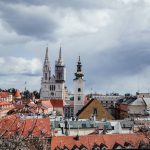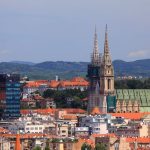
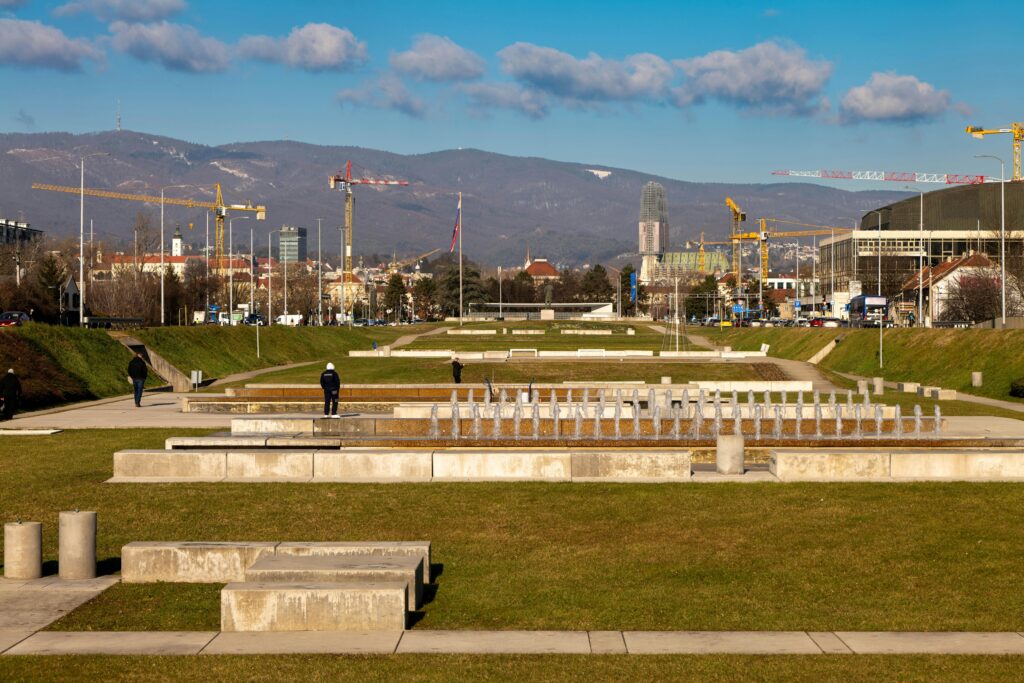
June the 6th, 2026 – Zagreb is still under reconstruction with cranes and scaffolding everywhere you turn, over 6 years after the earthquake struck. Foreign visitors are even beginning to question this slowness.
More than 6 years after the devastating March 2020 earthquake, many parts of central Zagreb remain covered in scaffolding, protective netting, and very ugly construction barriers. For residents, the sight has become part of everyday life. For visitors, however, it often comes as a surprise.
That contrast was recently highlighted after comments from a foreign visitor drew attention to the pace of reconstruction in the Croatian capital, reviving a question that many locals continue to ask themselves: why is the process taking so long?
The 5.5-magnitude earthquake that struck Zagreb on the 22nd of March 2020 caused significant damage across the city, particularly in the historic Upper Town and Lower Town districts. Hundreds of buildings were affected, including schools, hospitals, churches, museums, and residential blocks. Less than two years later, in December 2020, another major earthquake struck Sisak-Moslavina County, further stretching Croatia’s reconstruction capacity and resources.
Since then, billions of euros have been allocated through a combination of state funding, European Union support, and local budgets. Major public buildings have entered various stages of reconstruction, while thousands of private property owners have navigated a complex system of assessments, permits, applications, and financing procedures.
Yet despite visible progress in some areas, large sections of the city centre continue to show the scars of the earthquake. Zagreb remains under serious reconstruction long after both the earthquake was over and after people’s patience for it ran out.
One of the main reasons frequently cited by experts is the complexity of rebuilding within a historic urban environment. Many damaged buildings in central Zagreb are protected cultural heritage structures, meaning reconstruction must meet strict preservation requirements. This often extends project timelines considerably compared to standard construction works.
Administrative procedures have also played a role. Property ownership issues, permit approvals, contractor shortages, and rising construction costs have all contributed to delays. In many cases, apartment buildings contain multiple owners, requiring agreement between residents before work can proceed.
Labour shortages have added another layer of difficulty. Croatia’s construction sector has experienced growing demand in recent years, fuelled not only by reconstruction projects but also by infrastructure investments, tourism development, and private construction activity across the country.
For many residents, the issue is not whether reconstruction is happening, but how quickly. While completed projects demonstrate that progress is being made, unfinished facades, scaffolding-covered streets, and ongoing works continue to shape perceptions of the city centre.
The debate also touches on a broader question facing Zagreb: how should a modern European capital rebuild after a major natural disaster while preserving its architectural identity?
City officials and reconstruction authorities point to the scale of the challenge, noting that the process involves thousands of individual projects rather than a single coordinated construction effort. They argue that long-term structural safety and quality must take priority over speed.
Critics, however, contend that bureaucracy and administrative inefficiencies have unnecessarily prolonged the process, leaving residents and businesses dealing with years of disruption.
As Zagreb enters another summer tourism season, visitors walking through the city’s historic core will still encounter cranes, scaffolding, and construction sites. For some, they are signs of progress. For others, they are reminders of how much work remains to be done.
6 very long years on, reconstruction continues. And so does the debate over whether Croatia’s capital is rebuilding quickly enough.